Downton Abbey — in Manhattan

bells

Recently, my sister-in-law was planning a visit to New York City and when I asked her if there was anything in particular that she wanted to do, she said she would love to see Downton Abbey: The Exhibition. I hadn’t even heard about it, but it sounded like a good idea so I booked our tickets. Though I had only caught a few episodes of the series, I found that I was really looking forward to seeing the exhibit. And in the late afternoon of a cold winter’s day, we stepped into the world of Downton Abbey.

Edith

I was surprised to find that the exhibit was in the recently closed Lee’s Art store on 57th Street, a place I had frequented over the years. The windows that once displayed painting supplies, glittering frames, and whimsical toys, now held an equally enchanting display: images, items, and gifts relating to Downton Abbey — including an exquisite 1920’s dress in peacock blue and gold.

The New York City street was reflected in the window — scaffolding and yellow cabs, parkas and mounds of snow — and seemed a sort of symbolic contrast to the elegance of another era.

window contrast

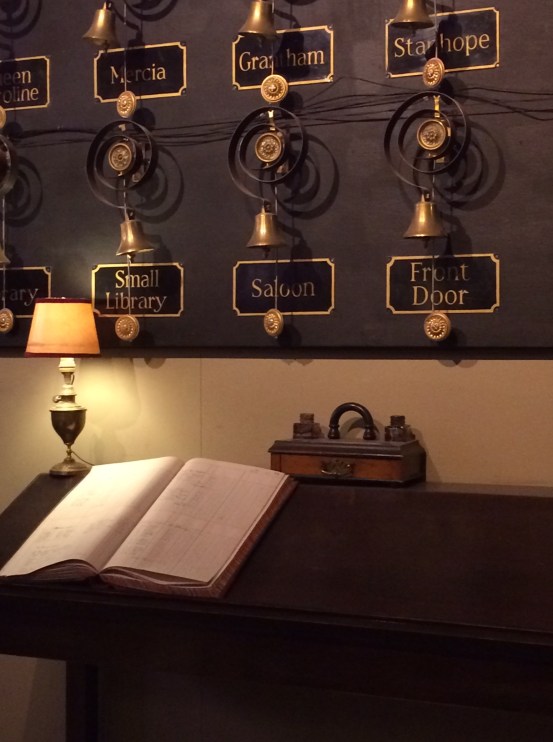
We strolled through the exhibit, laughing as we were greeted by holographic videos (?) of Mr. Carson and Mrs. Hughes welcoming us to Downton Abbey, before they had to hurry away. We entered the “downstairs” area and worked our way up.  There was the kitchen with something simmering on the stove, the carton of eggs, the sounds of chopping and pots and pans being moved about. There was Carson’s pantry with the decanter, and there were those famous room bells.

And there was the dining room with the beautifully set table.

dining table

One room had video snippets of different scenes from the series: the explosions and trenches of WWI shifted to tranquil interior scenes of a fire burning brightly in the library.
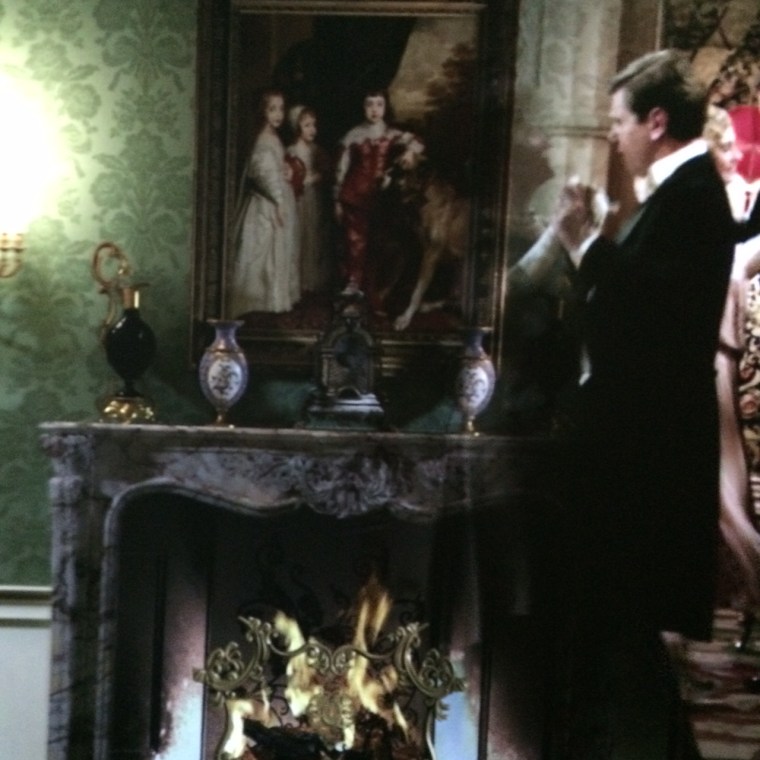
fireplace video

Another area was dedicated to short film excerpts featuring the acerbic wit of Violet Crawley. And throughout the exhibit were reminders of the period’s codes of conduct and rules of civility.

The clothes were beautiful, and I found myself lingering over the details of trim and beading and lace: the Edwardian opulence of Violet’s clothing, the shimmering elegance of the 1920’s dresses,

and those beautiful necklaces and earrings that complemented the clothing.

On every floor, in every room was the sense of a time gone by and the societal upheavals of yesteryear. One quote posed the idea that perhaps that earlier period was not so unlike our own times, with technology rushing us ahead, creating some disturbing trends, while offering other compensations.

Since I had only caught an occasional episode, I never got to know the characters and plots in the way that many people did.

So, on these snowy January evenings, I’ve started to watch the series from the beginning — paying extra close attention to the buttons and jewelry, the silverware and bells.


The Plaza Hotel – book cover

All the book covers in the Christmastime series feature an old-looking photograph set in winter. They to help establish a sense of place and give the impression of peering back in time. The images also portray places that are still in existence in Manhattan, so that the reader can feel it’s possible to step into the world of Christmastime by strolling through New York City, whether literally or imaginatively. Hence, the snowy photographs of a brownstone and several scenes from Central Park.

The covers must also reflect the content and tone of the books. I chose increasingly lonesome images and darker colors as the war years wore on, especially for Christmastime 1942 and Christmastime 1943.

Though 1944 was another terrible year, the Allies were clearly gaining the upper hand, and many people believed that the war in Europe would be over by Christmas. (The mid-December surprise count-offensive by the Germans, resulting in the Battle of the Bulge, quashed that hope, and the war raged on.)

But when December arrived, hope was in the air. For the cover of Christmastime 1944, I wanted an image that was lighter, brighter, and more hopeful. When I came across the image of the Plaza Hotel lit up at night, I thought it would be perfect for the story – especially since the hotel figures into one of the plots.

cover Christmastime 1944

If you’re ever in Manhattan, stop by the Plaza Hotel for lunch or tea. Stroll through the lobby to look at the beautiful bouquets of seasonal flowers, the mosaic floors, and the stained-glass ceiling in the Palm Court.


And if you’re in the Christmastime frame of mind, you just might catch a glimpse of a lovely woman in a 1940’s satin and chiffon green dress.

Plaza PP mosaic

Venice

venice sunset

An early, hushed Sunday morning in New York City. Cool air wafts through the open window. I sit at my kitchen table with a cup of tea from the set I bought in a little town outside of Portland over twenty years ago. My “cottage set” I’ve always called it – a round teapot and heavy mugs, deep blue with garlands of flowers on them, the handles like twisted branches. They always bring to mind the Cotswolds and thatched cottages with gardens – though I’m far from any kind of cottage existence.

A dense fog last night leaves the flowers in my window boxes dewy and fresh. In the distance, I hear a lone train whistle from the Sunnyside train yard, the early chirping of birds, the muted peal of faraway church bells, the low passing rumble of a car or two a few blocks over.

My mind is focused on the writing at hand – when in the morning quiet, I hear the click click of a woman’s heels on the sidewalk below – and immediately I’m back in Venice.

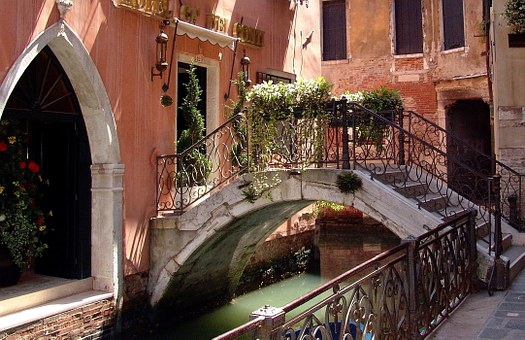
Venice beautiful bridge

Exhausted upon our arrival, we rested in the early evening, almost asleep. And through the open window, we heard for the first time the sound that would forever remind us of Venice: the clicking of women’s heels in otherwise silence, ever so slightly echoing in the narrow calli below – mysterious, intriguing, beguiling. Who is she? Why is she alone? Where is she going?

I take a sip of tea, glance out the window, and decide that I must go back there – to the city of soft summer evenings, canals and bridges, and breathtaking beauty.

venice end of day