It’s A Wonderful Life — a Christmas classic (and an inspiration for indie writers)

crop It's A Wonderful Life (1)

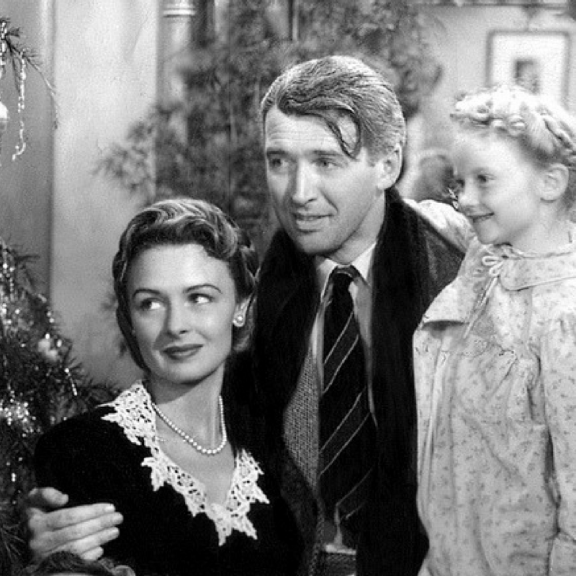
People often ask me what movies or books my Christmastime series is most similar to. For many reasons, the movie It’s A Wonderful Life comes to mind. It’s set during and just after WWII, it’s a story about love and family, the importance of friends and neighbors, and it’s about transformation.

Clarence

I happened to catch it on TV the other night, and though I know the movie by heart, I found that I loved it as much as ever.

on phone

The story behind the movie is also “wonderful,” and offers an inspirational example for today’s independent writers. The movie is based on a short story by Philip Van Doren Stern (1900 – 1984), an American author, editor, and Civil War historian.

The story goes that in “February 1938, Stern awoke with the story in mind. Inspired by a dream that was reminiscent of Charles Dickens’ 1843 A Christmas Carol, Stern wrote a 4,000 word short story called The Greatest Gift. He began work on it in 1939 but didn’t finish until 1943.

Dickens

Unable to find a publisher for his story, he printed two hundred copies of the story and distributed them as Christmas cards in 1943. One of the original palm-sized booklets came to the attention of a producer at RKO Pictures who purchased the rights, and then sold them to Frank Capra in 1945.” (Wikipedia)
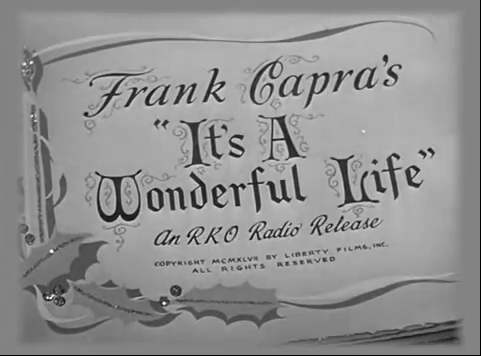
Frank Capra title

“From this humble beginning, a classic was born. Stern’s story captivated Capra, who said he ‘had been looking for [it] all [his] life.’ Capra’s beloved adaptation, It’s a Wonderful Life, was released in 1946,” (Zoetrope – www.all-story.com) and has become part of the American Christmas tradition.

bell on tree


The Christmastime stories — rural and small-town Midwest

The Christmastime books, stories of love and family on the home front during the World War II years, portray an America with one foot firmly in the past and the other poised on the threshold of change. The setting for these stories, for the most part, is New York City. However, a few storylines are set in the rural Midwest.

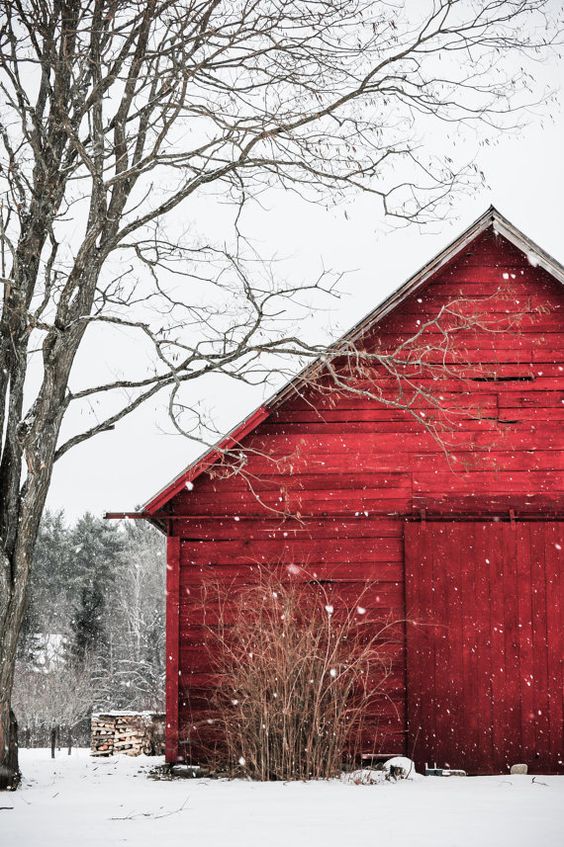
I was born and raised in small-town Illinois and the beauty of the landscape there — old farm houses set among fields and pastures, trains running to and from the small towns, the  woods and orchards that change with the time of year — has always had a strong pull on me. The seasons are rich and distinctive, and the snowy winter setting perfect for the Christmastime stories.

In the first book of the series, Christmastime 1940, we find that Charles Drooms’ past is deeply rooted in rural Illinois, and there are a few flashbacks to his boyhood and life on the farm that explain many of his decisions later in life.

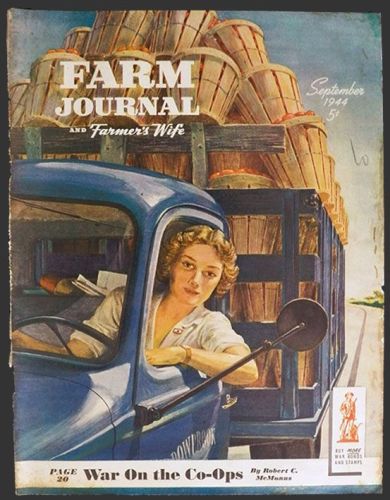
In a later book, there’s a scene where Lillian works on a series of illustrations depicting the role of women on the farm. With so many men enlisted, women had to step into the workforce and fill jobs that had recently been held by men. Lillian draws on her memories of visiting Kate’s farm in the summer of 1941.

postere farm woman

Beginning in Christmastime 1943, a key storyline takes place on Kate’s farm involving her daughters, Ursula and Jessica, and the German POWs who work on the farm while Kate’s sons are away at war. The scenes depict the connection of living close to the land with the rhythms of the seasons, and the rigor and back-breaking work required by farm life.

The farm scenes help to portray a period when time moved more slowly, and a place where most foods were locally grown and cooking was done from scratch.

A time when the home arts played an important role in day-to-day living,

and small-town life offered simple charm and the opportunity for visiting and shopping.

The tension between the beauty and bleakness of the Midwestern winter landscape also serves to reflect the complexities in Ursula, a young woman often driven by opposing impulses.

And on a larger scale, the small town and farm scenes offer a counterpoint to the New York City scenes. The tranquility and wholesomeness of the countryside serve as a reminder of how much was at stake in the war.

The rural setting also represents the tens of thousands of young men, such as Kate’s four sons, who left their small towns and farms to fight in Europe and the Pacific. For many of them, it was the first time ever leaving home. For them, the very idea of “home,” and everything it symbolized, became a deeply cherished and protected ideal.

pie and chair

(For more images evocative of the world of Christmastime, please visit my Pinterest boards at http://www.pinterest.com/lindamahkovec/)

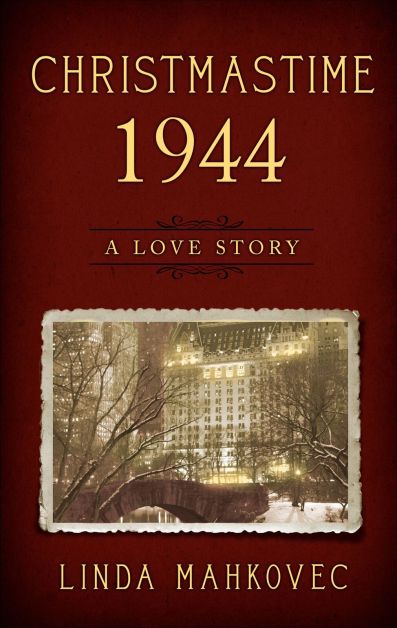
The Plaza Hotel – book cover

All the book covers in the Christmastime series feature an old-looking photograph set in winter. They to help establish a sense of place and give the impression of peering back in time. The images also portray places that are still in existence in Manhattan, so that the reader can feel it’s possible to step into the world of Christmastime by strolling through New York City, whether literally or imaginatively. Hence, the snowy photographs of a brownstone and several scenes from Central Park.

The covers must also reflect the content and tone of the books. I chose increasingly lonesome images and darker colors as the war years wore on, especially for Christmastime 1942 and Christmastime 1943.

Though 1944 was another terrible year, the Allies were clearly gaining the upper hand, and many people believed that the war in Europe would be over by Christmas. (The mid-December surprise count-offensive by the Germans, resulting in the Battle of the Bulge, quashed that hope, and the war raged on.)

But when December arrived, hope was in the air. For the cover of Christmastime 1944, I wanted an image that was lighter, brighter, and more hopeful. When I came across the image of the Plaza Hotel lit up at night, I thought it would be perfect for the story – especially since the hotel figures into one of the plots.

cover Christmastime 1944

If you’re ever in Manhattan, stop by the Plaza Hotel for lunch or tea. Stroll through the lobby to look at the beautiful bouquets of seasonal flowers, the mosaic floors, and the stained-glass ceiling in the Palm Court.


And if you’re in the Christmastime frame of mind, you just might catch a glimpse of a lovely woman in a 1940’s satin and chiffon green dress.

Plaza PP mosaic

Summer — in The Christmastime Series

5 Kate's farm summer trees fence.jpg!d - Copy

Summer. A languid time of year that seems to move more slowly than the other seasons. Perhaps because the days are longer, or perhaps because many people are on vacation and the children are out of school, or perhaps because more time is spent outside, it is a rich time of year that creates indelible memories.


Memories of summer occasionally surface for some of the characters in my WWII Christmastime series, where most of the action is set in the cold and snow of December.


Though the stories take place on the home front, mostly in New York City, the events of the war shape the characters’ lives, making them fearful, anxious, and dreading the unknown. Adding to the tension are the attacks that take place in December — Pearl Harbor in 1941, and the surprise German counter-offensive in December 1944 that began the Battle of the Bulge.

For these characters, summer memories of a gentler and safer time soften the harsh realities of  war-time living. They remember bike rides along country roads, gathering garden flowers to place on the kitchen table and in bedrooms, afternoon picnics, a moonlit swim.


One memory in particular evokes the beauty and longing of late summer. In Christmastime 1941, Charles takes Lillian and her two sons to visit his sister Kate, who lives on a farm in Illinois. Lillian and Kate sit on the farmhouse porch in the late afternoon.

Lillian helped Kate finish the laundry, and then sat with her on the front porch, shucking corn for dinner.


A beautiful August day surrounded them in all its fullness and simple charm. A gentle breeze rustled the leaves high in the pin oaks, and fluttered the laundry on the clothes line, causing the white billowing sheets to snap softly now and then. The wide porch surrounded them with views of the corn and soybean fields stretching to the horizon. To the east stood a cluster of tall trees, their leaves a dark, dusty, late-summer green, with some leaves already edged in brown. And before them, Kate’s flowers along the lane – a tall tangle of orange, yellow, white, and blues – tiger lilies and daisies, cornflowers and asters.


Lillian lifted her face to catch the afternoon breeze, and caught the scent of honeysuckle that covered the fence along the lane. 


The wind alternately muffled and then sharpened the sounds of Tommy and Gabriel playing horseshoes with Kate’s sons: dull thuds as the horseshoes fell on the earth, clinks of metal as they hit their mark or landed on each other, mixed with clapping, laughing, good-natured disputing. Lillian had felt suffused with a sense of well-being, surrounded by an earthy loveliness.

2 clover in sunlight

Afternoon picnics, gardens in bloom, ripe fruits and vegetables, lush trees and fields — summer is the time of year when some of our strongest memories are born.