Stars and stargazing often make their way into my stories. Beautifully symbolic of hopes and dreams, purity and wonder, they help to tell the inner stories of many of my characters.
Stars play a key role in the fourth book of the Christmastime series, Christmastime 1942: A Love Story (https://a.co/d/j2wI35u). Beginning with the storyline of Gino, the merchant seaman, the topic of stars develops into a unifying connection between him, Tommy and Gabriel, and Charles and Lillian.
The ethereal quality of stars also reveals the quietly eccentric character of Edith. She is comfortable with both the dreamy and pragmatic sides of her nature — and she is in love for the first time.
She opened the drawer to her nightstand and reached for her tin of oil pastels. She lifted the lid, and ran her fingers over the colors, choosing deep Prussian blue and cobalt, gold, silver, and umber. … A sketch emerged of two large pillows, a rumpled comforter, a soft bed under a large window. The night world outside dotted with stars. “Colors of midnight,” she wrote beneath it. She studied the bed, and added a few more lines, and then sprinkled a dusting of stars onto the pillows and blanket.
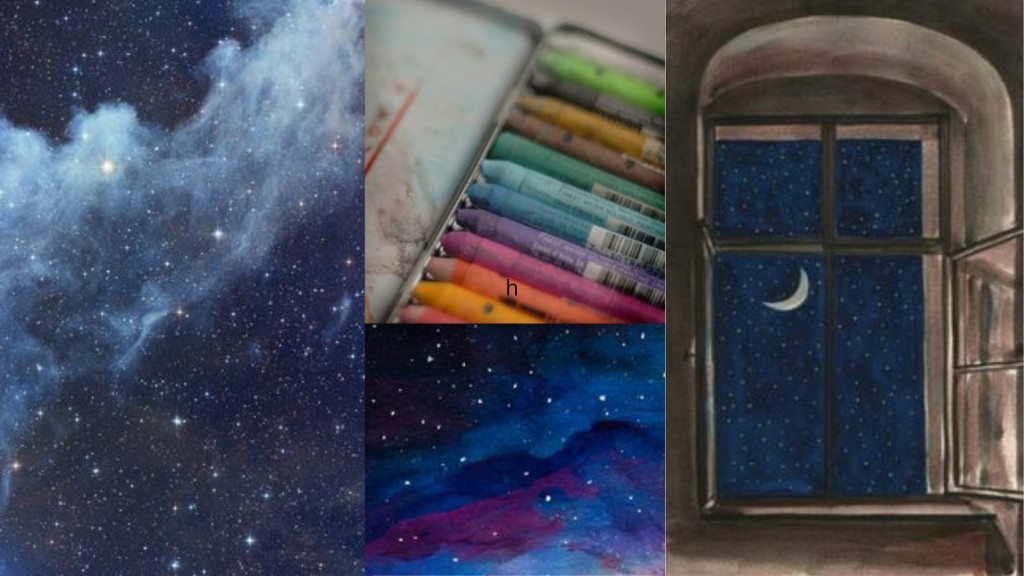
The main character, Lillian, is under pressure from her demanding boss to submit an idea for a poster contest. With the deadline looming, and despairing over the war and Charles’s imminent return to battle, she awakens in the middle of the night, seeking solace and inspiration.
She quietly went into the living room and turned on the lamp behind the couch. There was the telescope, pointing up, as if in readiness to search the heavens. She was glad for the stars, for their high, untouched beauty that could not be sullied by war, by humanity. She took out her sketch pad and pencils and began to draw.
A sketch began to take shape of a wounded soldier and his sweetheart looking at the same night sky, though thousands of miles apart. [Lillian] added more stars to the skies, trying to convey the belief that high above a war-torn world, the glittering firmament shone benevolently over earth, and that in the end, all would be well and whole again. Simple, humble, human love would help to piece the world back together again.

In The Notebooks of Honora Gorman: Fairytales, Whimsy, and Wonder (https://a.co/d/8Z1Igqu), the stars also offer inspiration for an artistic deadline, this time, a writing assignment.
Though Honora missed the stars, the lights of the city at night made up for it. She loved the contrast between the workaday gray of Manhattan and the magical, sparkling nights. The city, especially when viewed from afar, shone like a glittering firmament. A reversal of sorts, as if the starry night sky had been flipped to earth. She would never forget her first arrival, approaching the massive metropolis at night – entranced by the wide expanse of twinkly lights, a galaxy of stars that stretched as far as she could see.
Struggling to find an idea for her children’s writing class, Honora hits upon an idea.
What was that seedling trying to root in her story – something about the sky? The night sky. And how she missed it. Stars! She flooded with inspiration. And the fairytale, “Fallen Star” flows from her pen.

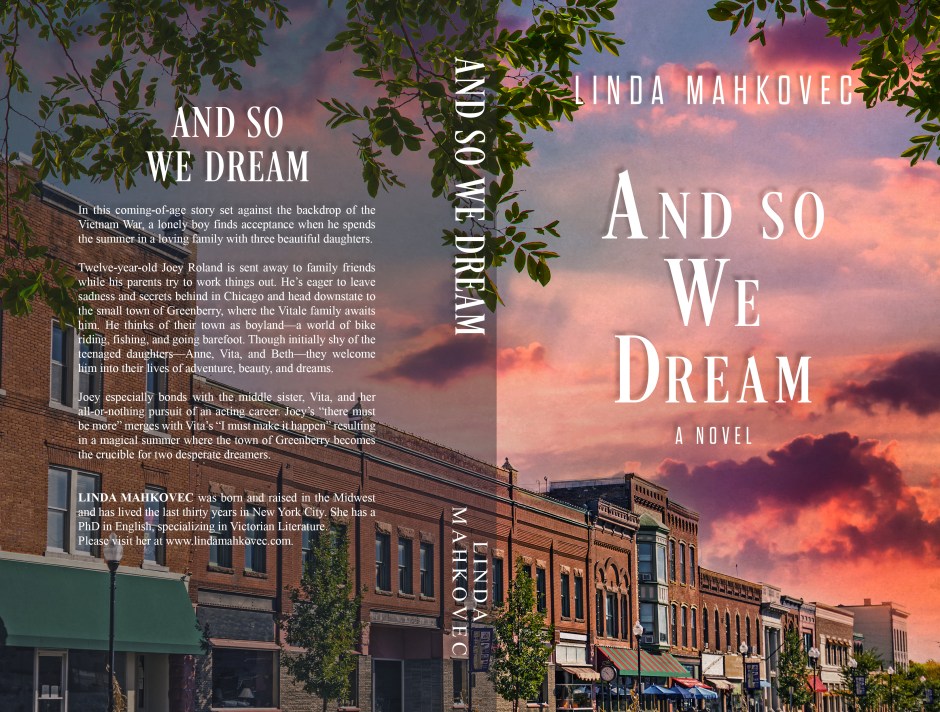
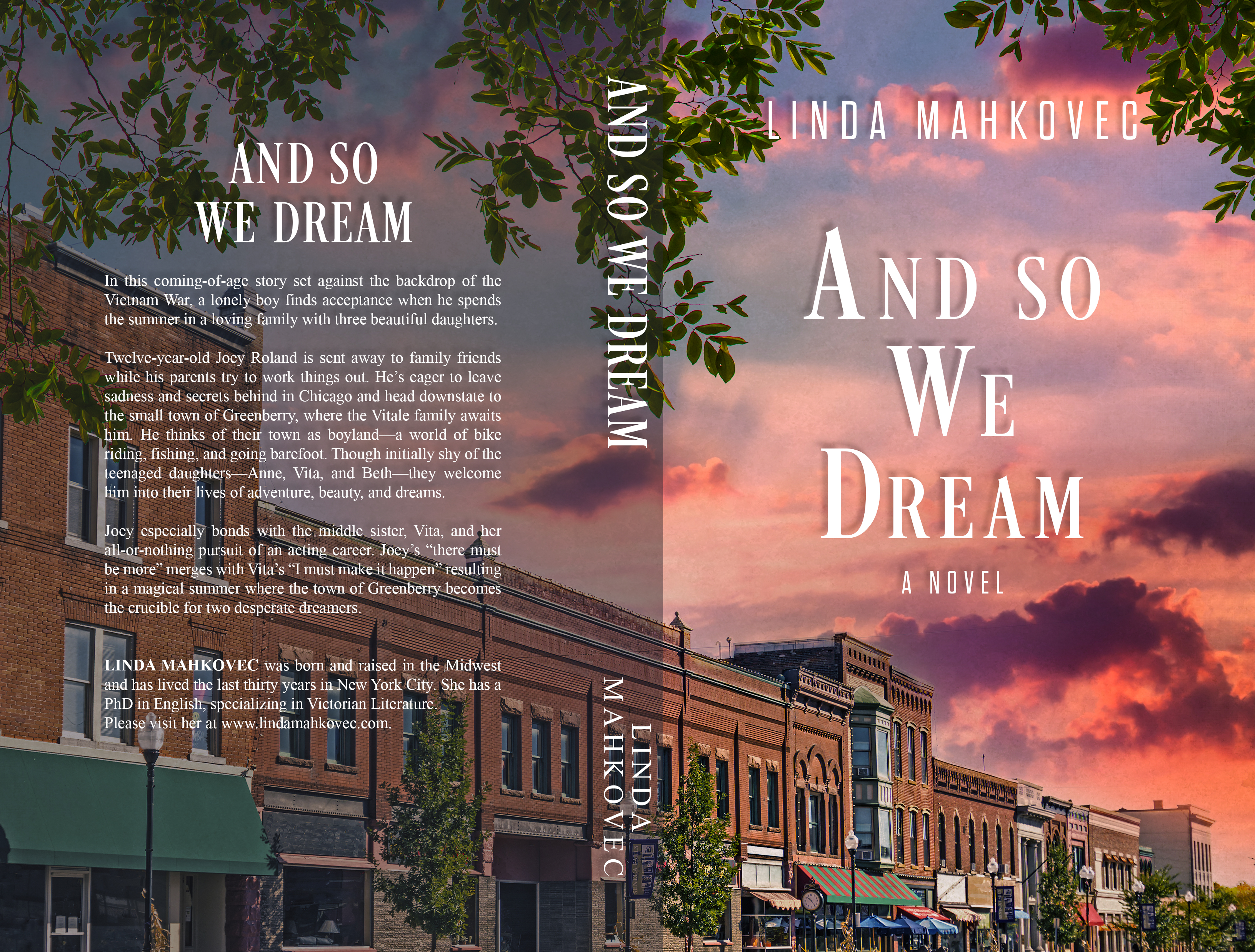
And So We Dream (https://a.co/d/0iM4uab) In another connection to the stars and the artist figure, the young dream-filled actress, Vita Vitale, also connects with the stars. In the beginning of the story, she and her older sister tell their younger sister about swimming in the lake at night.
“Did you guys go swimming—and not tell me?”
“We didn’t plan it,” said Anne. “After Diane’s we went out to the lake and . . .”
“In the dark?”
“Under the stars and a crescent moon,” said Vita. “A Pierrot moon, full of dreams. It was wondrous! Absolutely magical.”
Beth looked around the back seat to see if she was sitting on anything wet, then checked the floor. “Where are your swimsuits?” After a moment’s silence, she gasped. “You went skinny dipping?”
Anne shot Beth a warning glance in the rearview mirror. “Don’t you dare say anything about it at home.”
“I won’t. But I can’t believe it. Were there any boys there?” After no answer, she said, “You guys! Weren’t you embarrassed?”
“It was dark,” said Anne.
“Except for the glimmer on the water. It was like swimming through a thousand tiny stars.” Vita turned around to face them. “It was so beautiful…Like swimming in a fairy world.”
Later, far from her dreams, and weighed down by disappointment and a sense of failure, she taps into the beauty and magic of the night sky.
The warm summer night held the faint scents of grass and flowers. Vita inhaled deeply and filled her eyes with the inky sky aglitter with stars….Vita was alone. But didn’t feel at all lonely. This is what has been missing, she told herself. An infusion of beauty. And here it was. Right overhead. A fragrant summer night filled with shooting stars. Vita lay back and filled her eyes with the starscape….This is the counter to sadness, she thought. Beauty. Wonderment….She felt a profound sense of connection, and a reconnection to her dreams. It all came from the same deep place of beauty and love and yearning.
And a closing thought:
“The star-filled wonder of the night sky makes me magnificently small.” – Honora Gorman (from one of her many scraps of writing)














 Linda Mahkovec - Author