Downton Abbey — in Manhattan

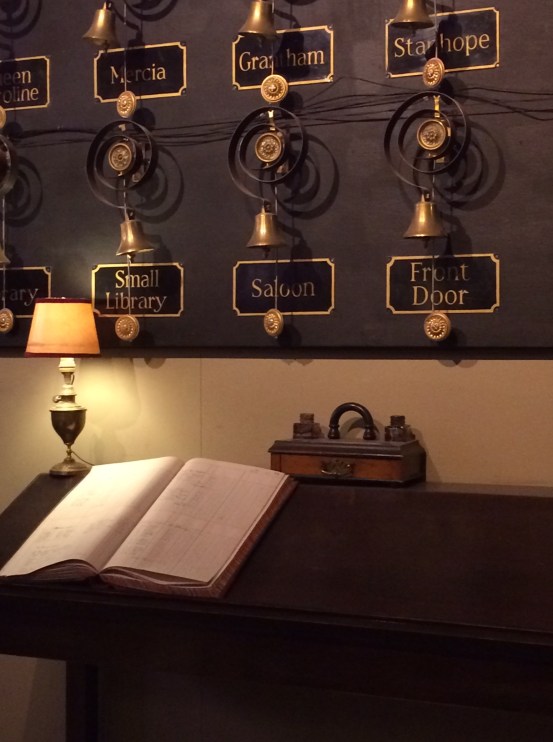
bells

Recently, my sister-in-law was planning a visit to New York City and when I asked her if there was anything in particular that she wanted to do, she said she would love to see Downton Abbey: The Exhibition. I hadn’t even heard about it, but it sounded like a good idea so I booked our tickets. Though I had only caught a few episodes of the series, I found that I was really looking forward to seeing the exhibit. And in the late afternoon of a cold winter’s day, we stepped into the world of Downton Abbey.

Edith

I was surprised to find that the exhibit was in the recently closed Lee’s Art store on 57th Street, a place I had frequented over the years. The windows that once displayed painting supplies, glittering frames, and whimsical toys, now held an equally enchanting display: images, items, and gifts relating to Downton Abbey — including an exquisite 1920’s dress in peacock blue and gold.

The New York City street was reflected in the window — scaffolding and yellow cabs, parkas and mounds of snow — and seemed a sort of symbolic contrast to the elegance of another era.

window contrast

We strolled through the exhibit, laughing as we were greeted by holographic videos (?) of Mr. Carson and Mrs. Hughes welcoming us to Downton Abbey, before they had to hurry away. We entered the “downstairs” area and worked our way up.  There was the kitchen with something simmering on the stove, the carton of eggs, the sounds of chopping and pots and pans being moved about. There was Carson’s pantry with the decanter, and there were those famous room bells.

And there was the dining room with the beautifully set table.

dining table

One room had video snippets of different scenes from the series: the explosions and trenches of WWI shifted to tranquil interior scenes of a fire burning brightly in the library.
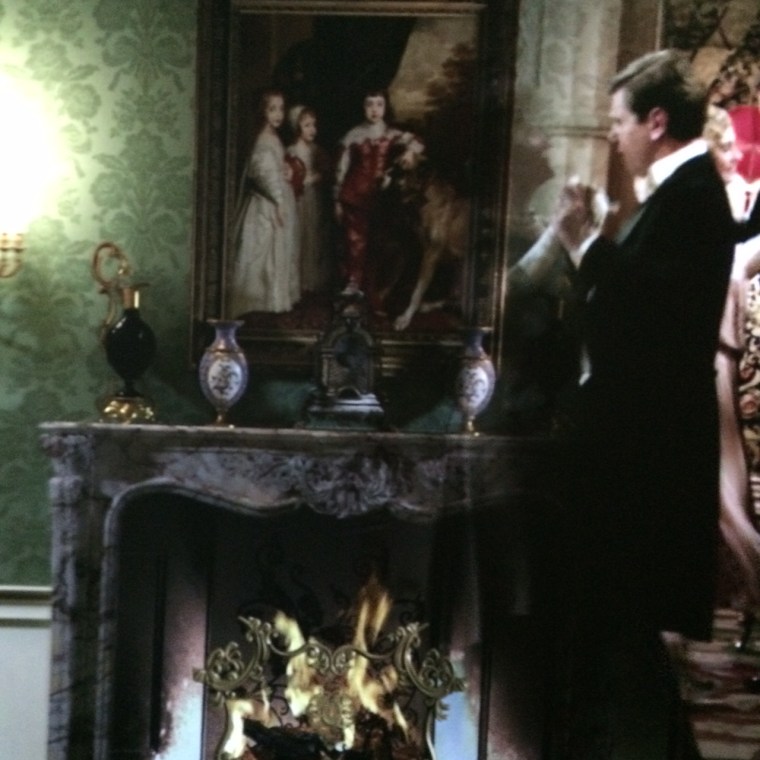
fireplace video

Another area was dedicated to short film excerpts featuring the acerbic wit of Violet Crawley. And throughout the exhibit were reminders of the period’s codes of conduct and rules of civility.

The clothes were beautiful, and I found myself lingering over the details of trim and beading and lace: the Edwardian opulence of Violet’s clothing, the shimmering elegance of the 1920’s dresses,

and those beautiful necklaces and earrings that complemented the clothing.

On every floor, in every room was the sense of a time gone by and the societal upheavals of yesteryear. One quote posed the idea that perhaps that earlier period was not so unlike our own times, with technology rushing us ahead, creating some disturbing trends, while offering other compensations.

Since I had only caught an occasional episode, I never got to know the characters and plots in the way that many people did.

So, on these snowy January evenings, I’ve started to watch the series from the beginning — paying extra close attention to the buttons and jewelry, the silverware and bells.
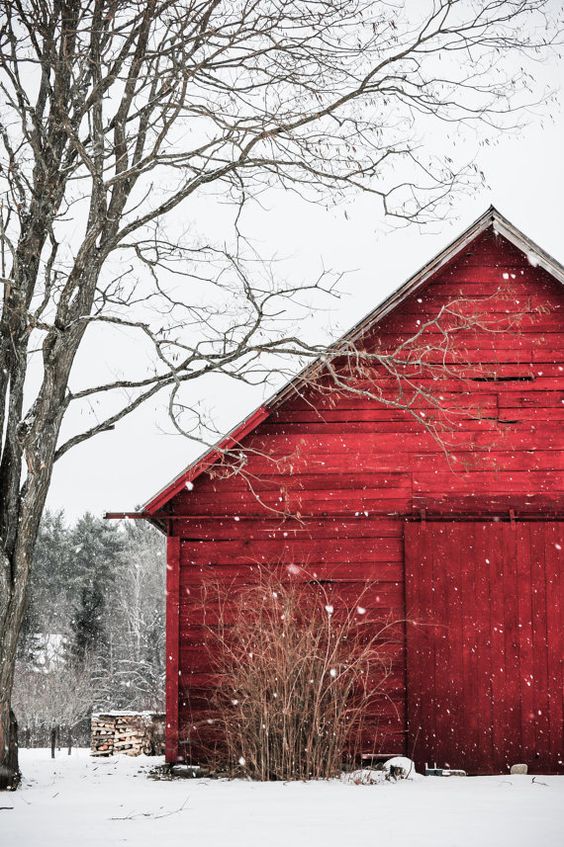
 

The Christmastime stories — rural and small-town Midwest

The Christmastime books, stories of love and family on the home front during the World War II years, portray an America with one foot firmly in the past and the other poised on the threshold of change. The setting for these stories, for the most part, is New York City. However, a few storylines are set in the rural Midwest.

I was born and raised in small-town Illinois and the beauty of the landscape there — old farm houses set among fields and pastures, trains running to and from the small towns, the  woods and orchards that change with the time of year — has always had a strong pull on me. The seasons are rich and distinctive, and the snowy winter setting perfect for the Christmastime stories.
In the first book of the series, Christmastime 1940, we find that Charles Drooms’ past is deeply rooted in rural Illinois, and there are a few flashbacks to his boyhood and life on the farm that explain many of his decisions later in life.

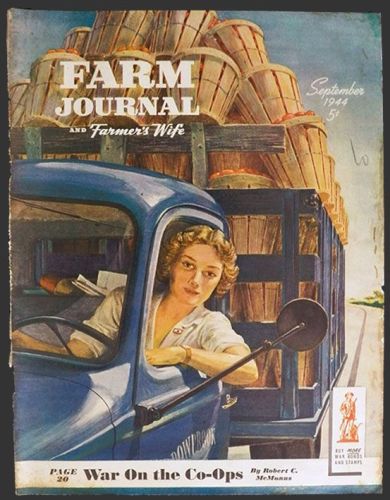
In a later book, there’s a scene where Lillian works on a series of illustrations depicting the role of women on the farm. With so many men enlisted, women had to step into the workforce and fill jobs that had recently been held by men. Lillian draws on her memories of visiting Kate’s farm in the summer of 1941.

postere farm woman

Beginning in Christmastime 1943, a key storyline takes place on Kate’s farm involving her daughters, Ursula and Jessica, and the German POWs who work on the farm while Kate’s sons are away at war. The scenes depict the connection of living close to the land with the rhythms of the seasons, and the rigor and back-breaking work required by farm life.

The farm scenes help to portray a period when time moved more slowly, and a place where most foods were locally grown and cooking was done from scratch.

A time when the home arts played an important role in day-to-day living,

and small-town life offered simple charm and the opportunity for visiting and shopping.

The tension between the beauty and bleakness of the Midwestern winter landscape also serves to reflect the complexities in Ursula, a young woman often driven by opposing impulses.

And on a larger scale, the small town and farm scenes offer a counterpoint to the New York City scenes. The tranquility and wholesomeness of the countryside serve as a reminder of how much was at stake in the war.

The rural setting also represents the tens of thousands of young men, such as Kate’s four sons, who left their small towns and farms to fight in Europe and the Pacific. For many of them, it was the first time ever leaving home. For them, the very idea of “home,” and everything it symbolized, became a deeply cherished and protected ideal.

pie and chair

(For more images evocative of the world of Christmastime, please visit my Pinterest boards at http://www.pinterest.com/lindamahkovec/)

London

St. Jpark 2

London is a labyrinth of parks and avenues, winding streets and narrow alleys that lead you from one beautiful neighborhood to another. A quick trip over Thanksgiving impressed me anew with the loveliness of London.

St. Ermin’s Hotel in Westminster was the perfect place to stay. It’s a beautiful Victorian building close to St. James Park and Buckingham Palace and just a block away from the Tube. They were just beginning to decorate for Christmas while we were there.

Hotle night

It had been many years since I last visited London, and for the most part, it was like seeing it through fresh eyes. The skyline had changed greatly — the London Eye alone transformed the feel of the skyline, as did the Shard.

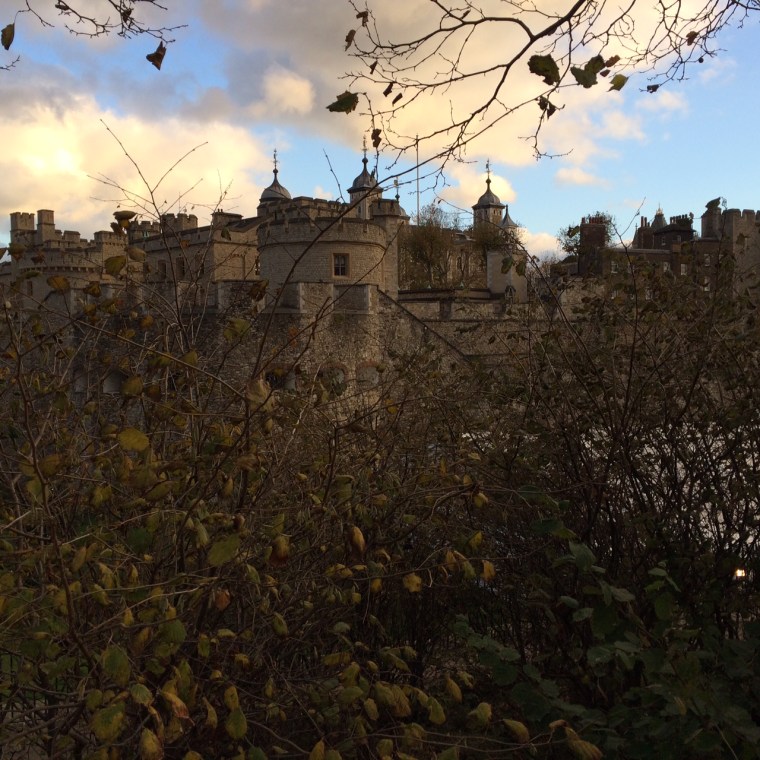
While we were visiting the Tower of London,

Tower 3

I was struck by the architectural layering of history: a row of Tudor-styled buildings stood behind the thousand-year-old crumbling walls of the fortress, and behind them both rose the Shard. All over London, the historical and the modern are intertwined.

Tower and Shard

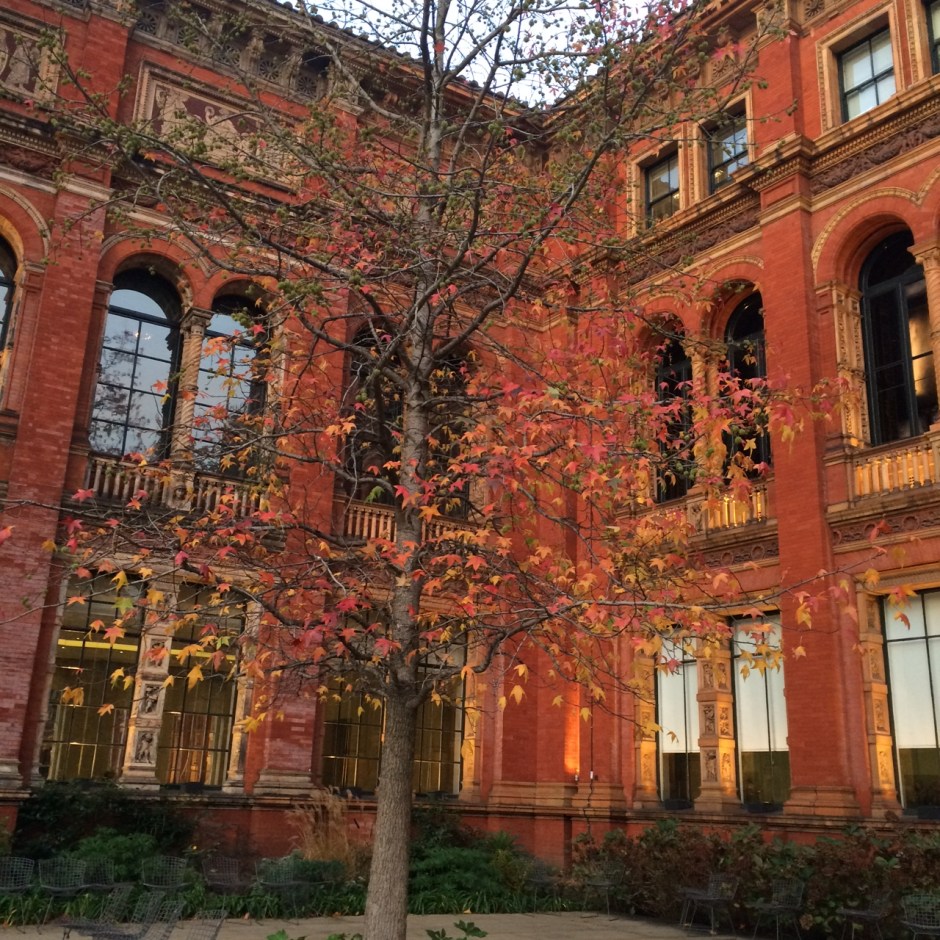
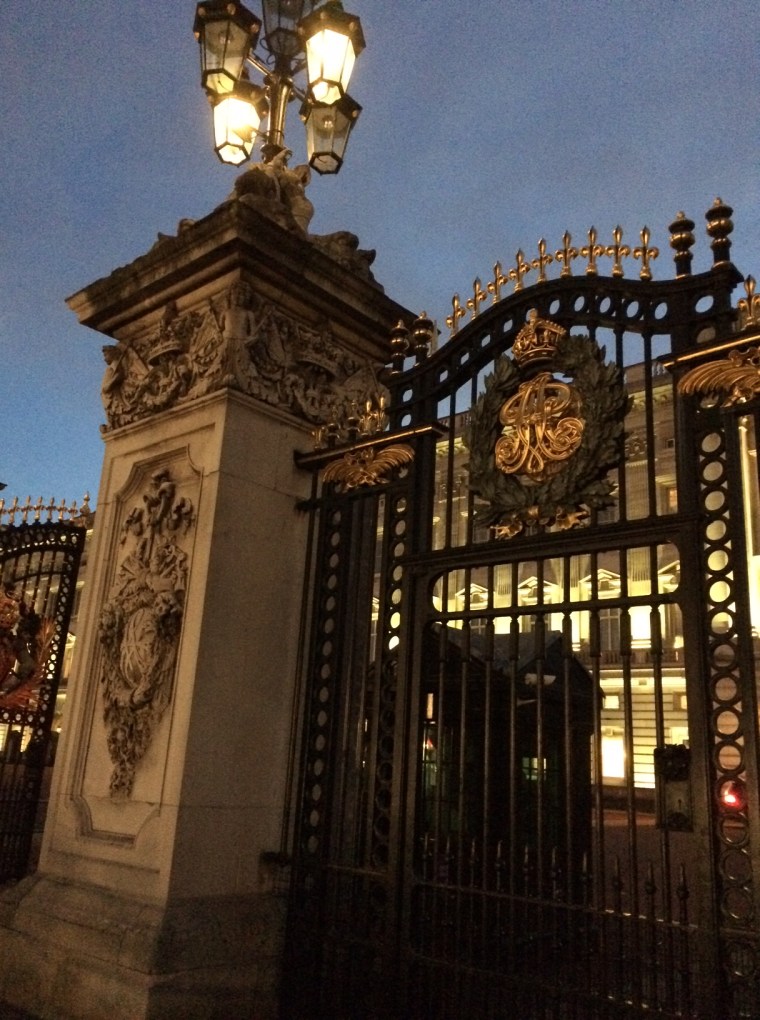
For the most part, my husband and I played tourists, going from one historical site to another: The Tower of London, the Victoria and Albert Museum, Trafalgar Square, the Westminster area (we were disappointed to find Big Ben covered in scaffolding). But Buckingham Palace was beautiful, especially at the end of day when the lights came on.

Buckingham closeup night

This was the first time I visited Notting Hill, and I was immediately taken with its charm. I would love to see it in the spring when the wisteria is in bloom.

NH window

Another afternoon we spent in the ever-changing Brick Lane neighborhood, full of wonderful Bangladeshi restaurants.

Brick Lane

Also new on this trip was a visit to the Leighton House, home of the artist Frederic, Lord Leighton. I fell in love with the exotic tiles and lamps, and the colors he surrounded himself with — rich peacock blue, muted gold, and dark woodwork.

Leighton House tiles

I’m glad we visited London in the late fall. Dusk came early, and by 4:30 the corner pubs and restaurants dotted the evening with golden light and a feeling of coziness and cheer spilled outside onto the sidewalks.

W pub night

Buildings that were beautiful by day took on a deeper beauty by night.

Ian night 3

The shopping areas of Oxford and Bond Streets, and Picadilly Circus glittered with tiny lights and holiday decorations, and were bustling with red double-decker buses and crowds of happy shoppers. A stroll through Selfridges offered a glimpse of the glamour depicted in the Masterpiece period drama Mr. Selfridge.

Stores like Harrods and Selfridges brought to mind the wonderful scene from Howard’s End where Mrs. Wilcox and Margaret Schlegel do their Christmas shopping.

howards-end-christmas-scene

Scenes from movies and books are everywhere. We took a train to the Baker Street Station and above ground saw the Sherlock Holmes Museum (with a long line outside).

Baker Street crop

At King’s Cross station there is Platform 9 and 3/4 from Harry Potter (with an even longer line of children waiting to get their photo taken). Though my list of things to see included the Charles Dickens Museum, the Samuel Johnson House, a stroll through Bloomsbury, and several other sites and parks, five days didn’t allow it.

So I’m already working on another list for my next visit.

Ian night white flowers


The Plaza Hotel – book cover

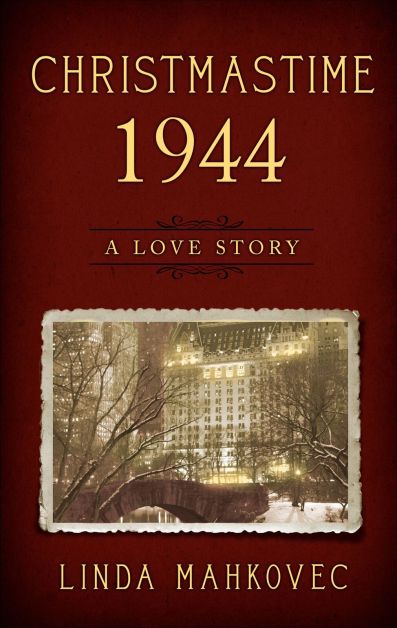
All the book covers in the Christmastime series feature an old-looking photograph set in winter. They to help establish a sense of place and give the impression of peering back in time. The images also portray places that are still in existence in Manhattan, so that the reader can feel it’s possible to step into the world of Christmastime by strolling through New York City, whether literally or imaginatively. Hence, the snowy photographs of a brownstone and several scenes from Central Park.

The covers must also reflect the content and tone of the books. I chose increasingly lonesome images and darker colors as the war years wore on, especially for Christmastime 1942 and Christmastime 1943.

Though 1944 was another terrible year, the Allies were clearly gaining the upper hand, and many people believed that the war in Europe would be over by Christmas. (The mid-December surprise count-offensive by the Germans, resulting in the Battle of the Bulge, quashed that hope, and the war raged on.)

But when December arrived, hope was in the air. For the cover of Christmastime 1944, I wanted an image that was lighter, brighter, and more hopeful. When I came across the image of the Plaza Hotel lit up at night, I thought it would be perfect for the story – especially since the hotel figures into one of the plots.

cover Christmastime 1944

If you’re ever in Manhattan, stop by the Plaza Hotel for lunch or tea. Stroll through the lobby to look at the beautiful bouquets of seasonal flowers, the mosaic floors, and the stained-glass ceiling in the Palm Court.


And if you’re in the Christmastime frame of mind, you just might catch a glimpse of a lovely woman in a 1940’s satin and chiffon green dress.

Plaza PP mosaic

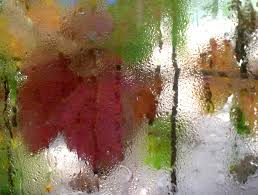
The autumn leaves are falling like rain…

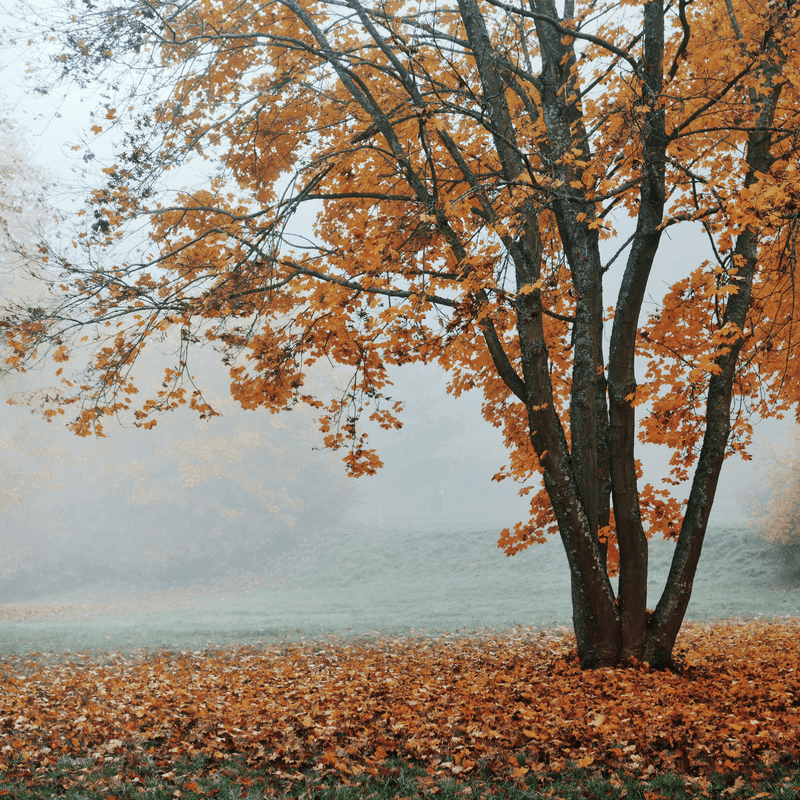
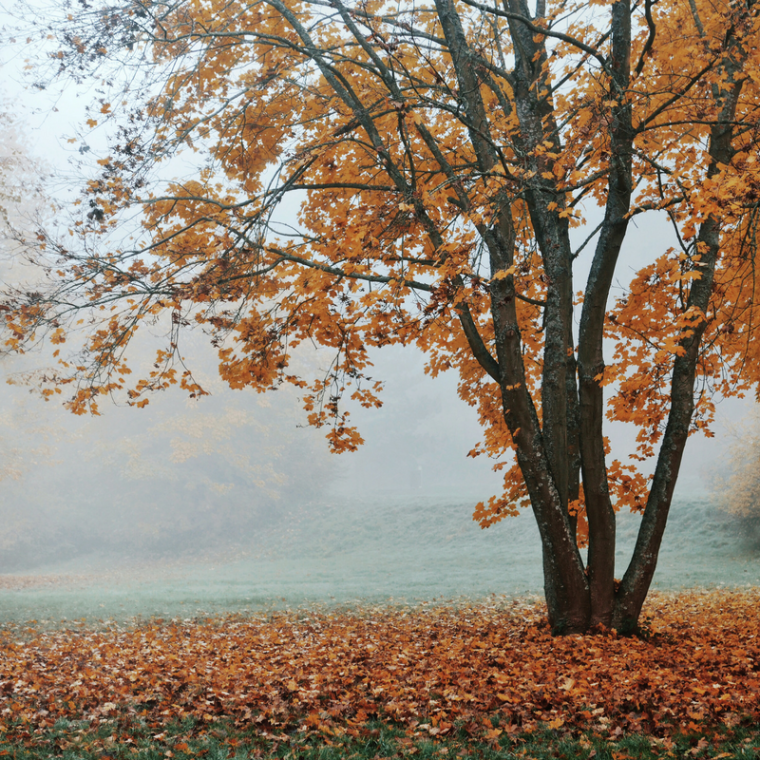
autumn mist and leaves

There’s a poem I’ve come across over the years that is simple, beautiful, and lyrical. It seems to find expression in different times, in slightly different wording. All the versions are evocative, stirring up rich images and emotions.

The autumn leaves are falling like rain,
Although my neighbors are all barbarians,
And you, you are a thousand miles away,
There are always two cups at my table.   – Tang Dynasty poem

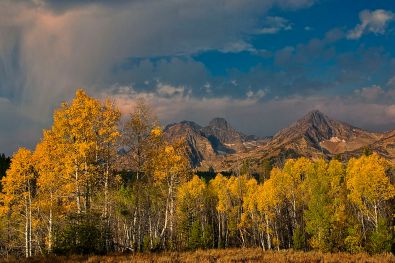
In this version, most likely translated from the original, I imagine a rugged landscape,

rugged autumn


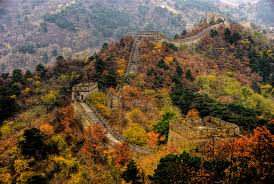
perhaps the Great Wall of China,

GW China autumn

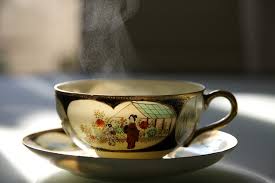
and a cup of tea.

Chinese teacup

A quick search reveals a few remarkable facts about the period the poem was written in: “China’s Tang Dynasty, 618-907, is often considered the Golden Age of Chinese poetry. During this period, poetry was an important part of social life at all levels of society. Scholars were required to master poetry for the civil service exams, but the art was theoretically available to everyone. Tang poetry has had an ongoing influence on world literature.” (Wikipedia)

However, there are other, similar versions of the poem. Perhaps the poem has been been translated in various ways throughout the years, or perhaps different poets were moved by the universality of the poem and reworked it for their time and place.

For example, this later version about an earlier period, is said to describe the far reaches of Britannia under Roman rule:

Here at the frontier 
There are fallen gods 
And my neighbours 
Are all barbarians 
Although you 
Are thousands of miles away 
There will always be on my table 
Your cup.

Different imagery comes to mind: the wall morphs to Hadrian’s Wall, the landscape shifts to bleak highlands. I imagine damp cloaks, stomping horses, tents pitched next to a sputtering campfire.

And more recently, these lines, close to the original, appear in John Fowles’ The Magus:

“Here at the frontier there are falling leaves; although my neighbors are all barbarians, and you, You are a thousand miles away. There are always two cups at my table.”

rainy leaves window

All the versions suggest forced separation – perhaps by war, conquest, travel of some sort – contrasted with the memory of friendship, the comforts of home, civility.  They speak of longing, memory, and the hope for future togetherness. And most of all, they express that it’s the simple things in life that have the greatest pull on us.


Oregon


soft sunset Vista House

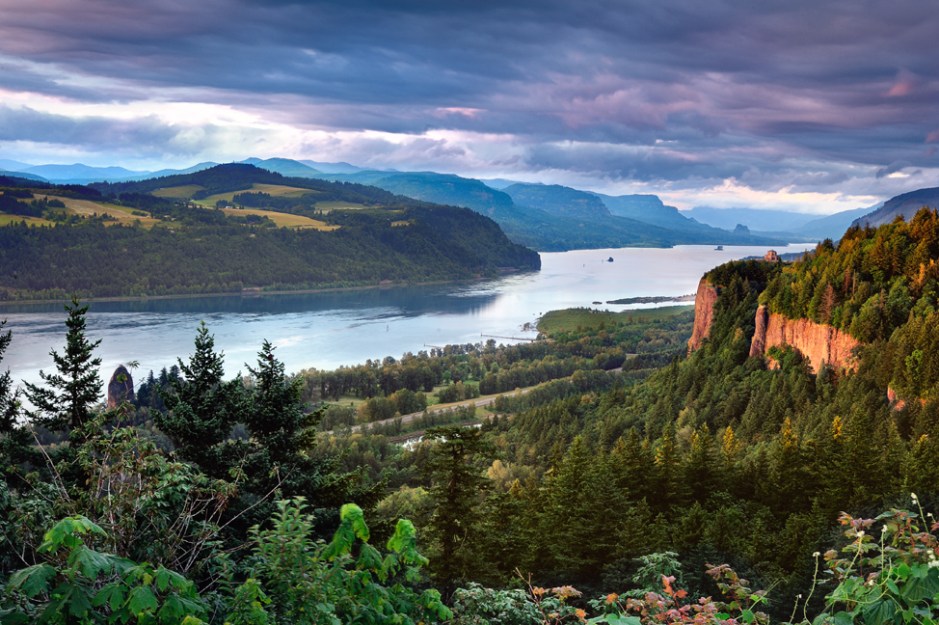
Every time I visit Oregon I’m left with the impression of the past and present mixing and shifting in a layering of influences. Though this is true of most places, it seems more pronounced in Oregon. My sister and her family live in Oregon and I’m lucky enough to visit there once a year, each time seeing someplace new.

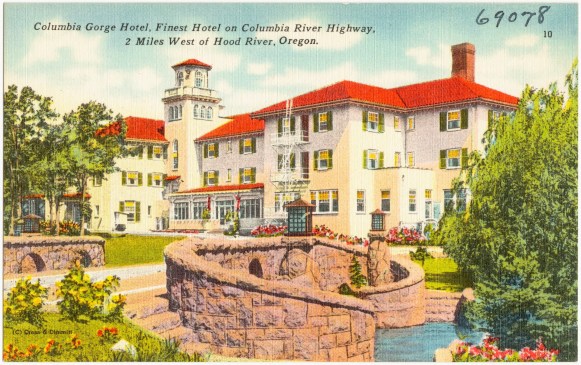
My visit this time began with a wedding at the Columbia Gorge Hotel, in Hood River. Mount Hood, majestic and always covered in snow, forms a backdrop to the hotel when viewed from the Washington side of the river.

The historic mission-styled hotel was built in the 1920s and retains the glamour that once attracted the likes of Rudolph Valentino and Clara Bow.

Old postcard Columbia River Gorge Hotel

“These were the days of steamers navigating the waters of the Columbia River from the Cascades to The Dalles. To alert the hotel, the captains would sound the whistle once for each guest he had on board. Maids would then quickly make up the appropriate number of beds….Simon Benson [owner] had just helped complete what many of the era claimed to be the world’s most beautiful road, the Columbia Gorge Scenic Highway. Benson’s dream was to create an opulent hotel for travelers at the end of this road.”

Source: ColumbiaGorgeHotel.com website, 2015

A picturesque stream, crossed by small stone bridges, runs through the grounds and ends in a rushing 90-foot waterfall that plunges into the Columbia River.

The river itself is steeped in the older history of the Lewis and Clark Expedition of 1804-1806, which began in St. Louis and ended where the Columbia River empties into the Pacific.

In fact, the very waterfall on the hotel grounds (the Wah Gwin Gwin Falls) is mentioned in their journals: “a butifull cascade falling over a rock of about 100 feet …” [Clark, October 29, 1805]. Their journals also describe the “Indian houses” along this section of the river and the sand bars “where the Indians caught fish.”

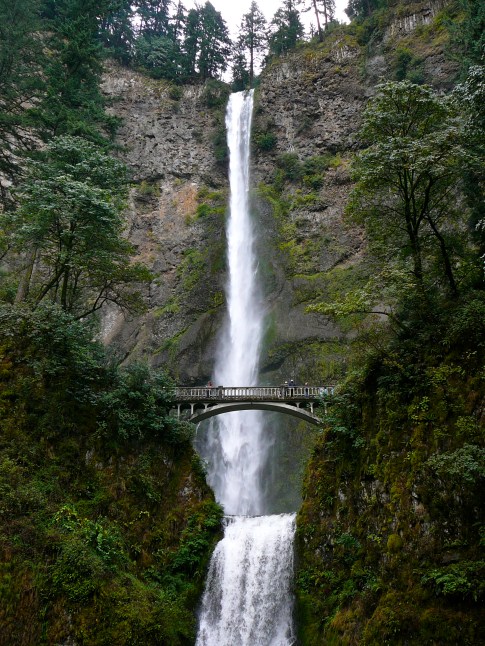
The Oregon landscape is imbued with Indian names that point to a deeper past, rich with the histories and legends of different tribes. Not far from the Columbia River is the stunning Multnomah Falls, one of the most photographed waterfalls in the world, and bound with the Wasco legend of a noble Indian maiden who sacrificed herself for her people.

Multnomah Falls free

The rest of my trip was spent a few hours south, near Roseburg. The Umpqua River dominates this area. Wide, rocky, and breathtakingly beautiful, the river cascades down from the mountains and flows to the Pacific. Where the river widens and slows, the South Umpqua, people “float” the river on rafts, inner tubes, and canoes.

The area is noted for its waterfalls, and hiking to them you can’t help but imagine a more distant time and feel the presence of the various tribes who walked the forest paths, hearing the same deafening roar of the waterfalls and feeling the same cooling mists.

A more recent layer of history woven into the landscape is that of the early settlers. There are places, such as Canyonville, where the ruts from the covered wagons can still be seen, evidence of the people who passed through the Applegate River and along the Rogue River. Some of the names of towns are reminders of the pioneers, and perhaps their impressions of places: Looking Glass, Steamboat, Riddle, Remote.

The valleys are still full of farms and ranches and orchards that were started by the pioneers. Century farms, “continuously owned by a single family for 100 years or more,” (Wikipedia) are plentiful. Some of the farms are beautifully preserved and give a glimpse into a harmonious way of living that was intricately bound with the seasons and the land.

Centruy farm

Other barns and farm structures, seen from the road, sag with the weight of time, or have collapsed completely.

More recent in the agricultural landscape are the vineyards, that are increasingly being planted. Though “settlers to the Oregon Territory planted grapes as early as the 1840s…the production of wine has only been a significant industry in Oregon since the 1960s” (Wikipedia). The Willamette Valley alone has over 500 wineries. Some are perched on hilltops that overlook rows of vines and give the countryside a European feel. Others, set along rushing rivers, are distinctly Oregonian in feel.

vineyard

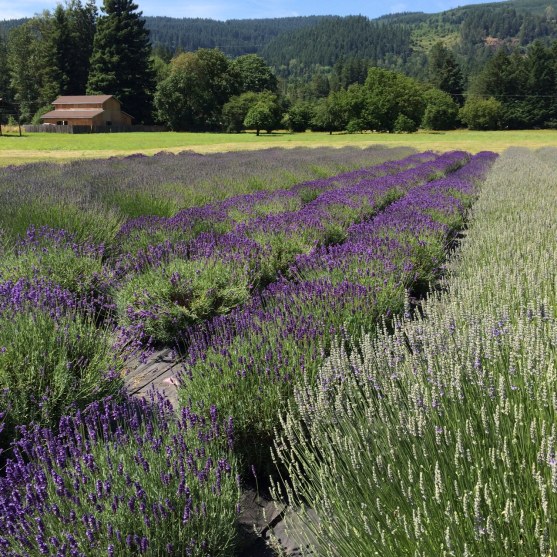
Oregon is also famous for its flowers, and on this visit taken at the end of June and early July, we sought out some fields of lavender. Though they were not quite in full bloom, their fragrance was strong — fresh, clean, and uplifting — and I bought some vials of lavender oil to take with me back to New York. So much of the landscape inspires a sense of beauty and well-being and the lavender oil seems to capture that.

lavender field

On my last evening in Oregon, we took a walk along a country road that overlooked the valley below. The coastal clouds, like a slow-moving wave, gently blanketed the rolling hills, and the setting sun cast the farmland below in a soft golden light. Magical.

sunset end