October

autumn lake

There’s an old green-covered book I open this time of year. The spine is split in some parts, the lettering on the cover is faded. It’s a book of poems by Robert Frost that my mother gave to me in high school. It was already worn back then. I don’t know if she bought it used somewhere around town or if someone made a gift of it to her years before. It wasn’t a formal presentation or given to mark a special occasion. It was like the other things she gave to us – a sort of “here’s something you might enjoy,” or “take a look at this.” Items that would simply appear on our dressers without any note at all – Classic Comics for my brothers, a porcelain bluebird for my sister’s collection, a red maple leaf, an exotic stamp off a letter from her brother who traveled widely. Things that would delight, pique our curiosity, entertain, or answer to inner longings.

The book of poems resonated deeply with me, especially the ones in the beginning of the book from the section “A Boy’s Will.” The autumn poems in particular became the ones that most spoke to me. “October” might have been the first poem I ever memorized, outside of school assignments. I memorized it because I wanted the words inside me, I wanted to walk through an autumn day and have the words at the ready: “O hushed October morning mild, Thy leaves have ripened to the fall, Tomorrow’s wind, if it be wild, Should waste them all.”

CP autumn bridge

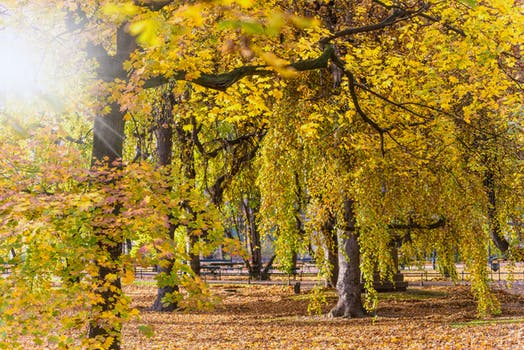
These many years later, the words are still there. As I walk through the neighborhood or cut through Central Park, a solitary leaf might float down from a tree on a mild autumn day, and I hear the words: “Release one leaf at break of day, At noon release another leaf.” The birds in the autumn sky might caw and without any prompting my heart recites: “The crows above the forest call; Tomorrow they may form and go.”
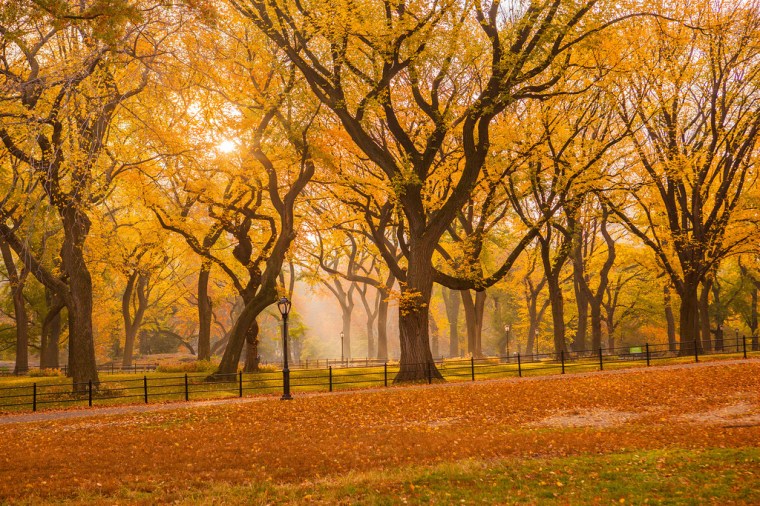
CP yellow elms

The simple book of poems remains the touchstone of autumn for me – it embodies the solitary, the nostalgia and memories of other Octobers, and the deep connection of inner yearning with outer seasonal beauty.

book with leaves

(Thank goodness Robert Frost didn’t stop at October. His poem “My November Guest” soon became my favorite.)

yellow leaf on bench

Autumn and Poetry


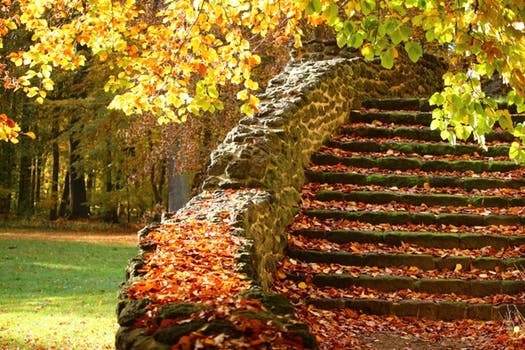
leaves on steps

Autumn and poetry go hand in hand. There is something inherently nostalgic and meditative about this time of year that points the mind to introspection. End-of-year wistfulness mixes with the excitement of going back to school, crisper weather, and the coming holidays.

Some poems set this emotionally rich time of year against the splendor of fall, as in John Keats’s “To Autumn” — “Season of mists and mellow fruitfulness…”

Sept pond w bridge

and Robert Frost’s “The Road Not Taken” — “Two roads diverged in a yellow wood…”

a yellow wood

Other poems capture the elegiac melancholy of autumn, as in Gerard Manley Hopkins’s “Spring and Fall”  to a young child:

goldengrove

MÁRGARÉT, áre you gríeving
Over Goldengrove unleaving?
Leáves, like the things of man, you
With your fresh thoughts care for, can you?
Áh! ás the heart grows older
It will come to such sights colder
By and by, nor spare a sigh
Though worlds of wanwood leafmeal lie;
And yet you wíll weep and know why.
Now no matter, child, the name:
Sórrow’s spríngs áre the same.
Nor mouth had, no nor mind, expressed
What heart heard of, ghost guessed:
It is the blight man was born for,
It is Margaret you mourn for.

stone stairs

On these beautiful fall days, curl up with a good book on a mild September afternoon, or in the evenings that now descend earlier. Find a good poem and let the lines run through your head as you kick through the autumn leaves and take in this season of nostalgia, excitement, and beauty.

colored leaves

Summer — in The Christmastime Series

5 Kate's farm summer trees fence.jpg!d - Copy

Summer. A languid time of year that seems to move more slowly than the other seasons. Perhaps because the days are longer, or perhaps because many people are on vacation and the children are out of school, or perhaps because more time is spent outside, it is a rich time of year that creates indelible memories.


Memories of summer occasionally surface for some of the characters in my WWII Christmastime series, where most of the action is set in the cold and snow of December.


Though the stories take place on the home front, mostly in New York City, the events of the war shape the characters’ lives, making them fearful, anxious, and dreading the unknown. Adding to the tension are the attacks that take place in December — Pearl Harbor in 1941, and the surprise German counter-offensive in December 1944 that began the Battle of the Bulge.

For these characters, summer memories of a gentler and safer time soften the harsh realities of  war-time living. They remember bike rides along country roads, gathering garden flowers to place on the kitchen table and in bedrooms, afternoon picnics, a moonlit swim.


One memory in particular evokes the beauty and longing of late summer. In Christmastime 1941, Charles takes Lillian and her two sons to visit his sister Kate, who lives on a farm in Illinois. Lillian and Kate sit on the farmhouse porch in the late afternoon.

Lillian helped Kate finish the laundry, and then sat with her on the front porch, shucking corn for dinner.


A beautiful August day surrounded them in all its fullness and simple charm. A gentle breeze rustled the leaves high in the pin oaks, and fluttered the laundry on the clothes line, causing the white billowing sheets to snap softly now and then. The wide porch surrounded them with views of the corn and soybean fields stretching to the horizon. To the east stood a cluster of tall trees, their leaves a dark, dusty, late-summer green, with some leaves already edged in brown. And before them, Kate’s flowers along the lane – a tall tangle of orange, yellow, white, and blues – tiger lilies and daisies, cornflowers and asters.


Lillian lifted her face to catch the afternoon breeze, and caught the scent of honeysuckle that covered the fence along the lane. 


The wind alternately muffled and then sharpened the sounds of Tommy and Gabriel playing horseshoes with Kate’s sons: dull thuds as the horseshoes fell on the earth, clinks of metal as they hit their mark or landed on each other, mixed with clapping, laughing, good-natured disputing. Lillian had felt suffused with a sense of well-being, surrounded by an earthy loveliness.

2 clover in sunlight

Afternoon picnics, gardens in bloom, ripe fruits and vegetables, lush trees and fields — summer is the time of year when some of our strongest memories are born.

Beautiful Evening / Beau Soir


stream blog header

Sometimes the words of a phrase or sentence jars your center and subtly slips into your core, lodging there. It may be years later, or even decades, that you realize they have become a part of you. Many years ago, I came across a poem that had such an effect on me — “Beau Soir” by Paul Bourget, that Claude Debussy set to music.

Beau Soir

Lorsque au soleil couchant les rivières sont roses,
Et qu’un tiède frisson court sur les champs de blé,
Un conseil d’être heureux semble sortir des choses
Et monter vers le coeur troublé.
Un conseil de goûter le charme d’être au monde
Cependant qu’on est jeune et que le soir est beau
Car nous nous en allons,
Comme s’en va cette onde:
Elle à la mer,
Nous au tombeau.

wheat field sunset

Beautiful Evening

When streams turn pink in the setting sun,

And a slight shudder rushes through the fields of wheat,

A plea for happiness seems to rise from all things

And it climbs up towards the troubled heart.

A plea to relish the charm of life

While there is youth and the evening is fair,

For we pass away as the wave passes: 

The wave to the sea, and we to the grave.

The tender intimacy of the poem, simple yet profound, stirred something deep inside and I sought out such end-of-day streams and fields, and later, ocean sunsets. The poem gave birth to a never-ending desire to seek out and become part of such moments of tranquil beauty.

pink purple ocean

It created a sort of urgency to embrace the loveliness of life — “while there is youth and the evening is fair.”