The Plaza Hotel – book cover

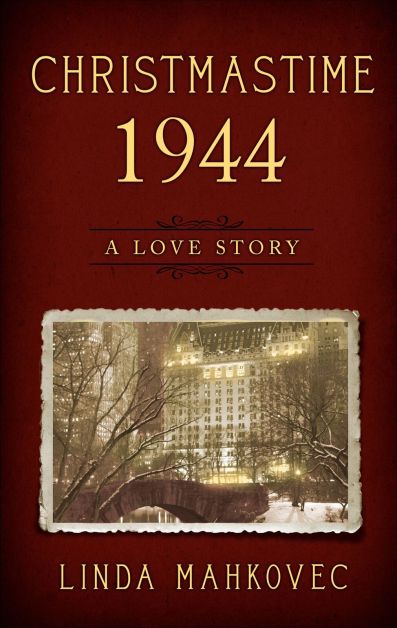
All the book covers in the Christmastime series feature an old-looking photograph set in winter. They to help establish a sense of place and give the impression of peering back in time. The images also portray places that are still in existence in Manhattan, so that the reader can feel it’s possible to step into the world of Christmastime by strolling through New York City, whether literally or imaginatively. Hence, the snowy photographs of a brownstone and several scenes from Central Park.

The covers must also reflect the content and tone of the books. I chose increasingly lonesome images and darker colors as the war years wore on, especially for Christmastime 1942 and Christmastime 1943.

Though 1944 was another terrible year, the Allies were clearly gaining the upper hand, and many people believed that the war in Europe would be over by Christmas. (The mid-December surprise count-offensive by the Germans, resulting in the Battle of the Bulge, quashed that hope, and the war raged on.)

But when December arrived, hope was in the air. For the cover of Christmastime 1944, I wanted an image that was lighter, brighter, and more hopeful. When I came across the image of the Plaza Hotel lit up at night, I thought it would be perfect for the story – especially since the hotel figures into one of the plots.

cover Christmastime 1944

If you’re ever in Manhattan, stop by the Plaza Hotel for lunch or tea. Stroll through the lobby to look at the beautiful bouquets of seasonal flowers, the mosaic floors, and the stained-glass ceiling in the Palm Court.


And if you’re in the Christmastime frame of mind, you just might catch a glimpse of a lovely woman in a 1940’s satin and chiffon green dress.

Plaza PP mosaic

Autumn Orchards

red apples

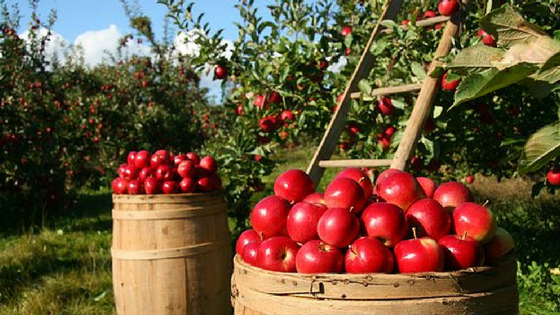
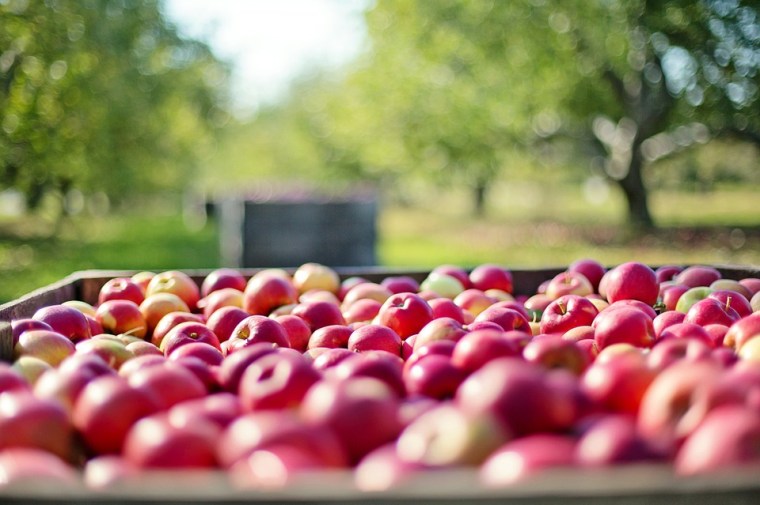
A trip to the orchard always feels like stepping back in time, especially at this time of year. There is something quaint and old-fashioned about the crates of red, green, and yellow apples, the rows of trees and pumpkin fields under an open sky, the warm colors of autumn’s harvest all around.

Even the things you can buy at an orchard are wholesome and picturesque. Besides bags of apples, there are rows of jams and honey, pumpkins and gourds, and ears of Indian corn in those gorgeous colors that always surprise.

And who can pass up the apple cider, the caramel apples, and the apple cider donuts?

There were several orchards around the small town in Illinois where I grew up. But there was one we went to every fall, making almost weekly trips to buy apples. We’d also buy jars of apple butter, homemade peanut brittle, and containers of popping corn. Once I was visiting home during the Fall Festival and was lucky enough to find beautiful bunches of bittersweet for sale. They were tied in thick clusters, vibrant in color. I bought several bunches and they decorated my NYC apartment for many years.

The old-fashioned, romantic allure of the orchard  found its way into my WWII era Christmastime series. The main character, Lillian, was raised in upstate New York where the seasonal beauty of the orchards and fields influenced her as an artist. She moves to the city, but her sister, Annette, runs an orchard with her husband. Lillian is grateful to have that haven to return to, where she can reconnect with her girlhood and enjoy the pleasures of country living. And her two boys, Tommy and Gabriel, love the freedom of running through the orchard and playing in the cider house. And sometimes, they celebrate Christmas there.

orchard apples on ground

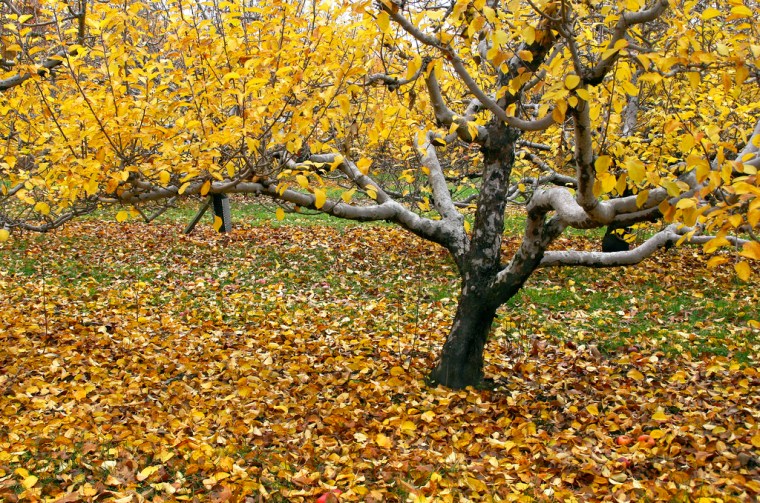
This time of year is all too brief — the harvest season, apples and pumpkins, the colors of fall, sweater weather. Soon the trees will soon lose their leaves, the temperatures will drop, and the orchards will close their doors.

orchard yellow leaved tree

Before that happens, make a trip to an orchard — crunch into a juicy apple, take some cider home with you, treat yourself to a caramel apple. Or just stroll around the earthy charm of the orchard, and savor this beautiful time of year.

orchard path fall


Late September — Central Park

1 trees yellow

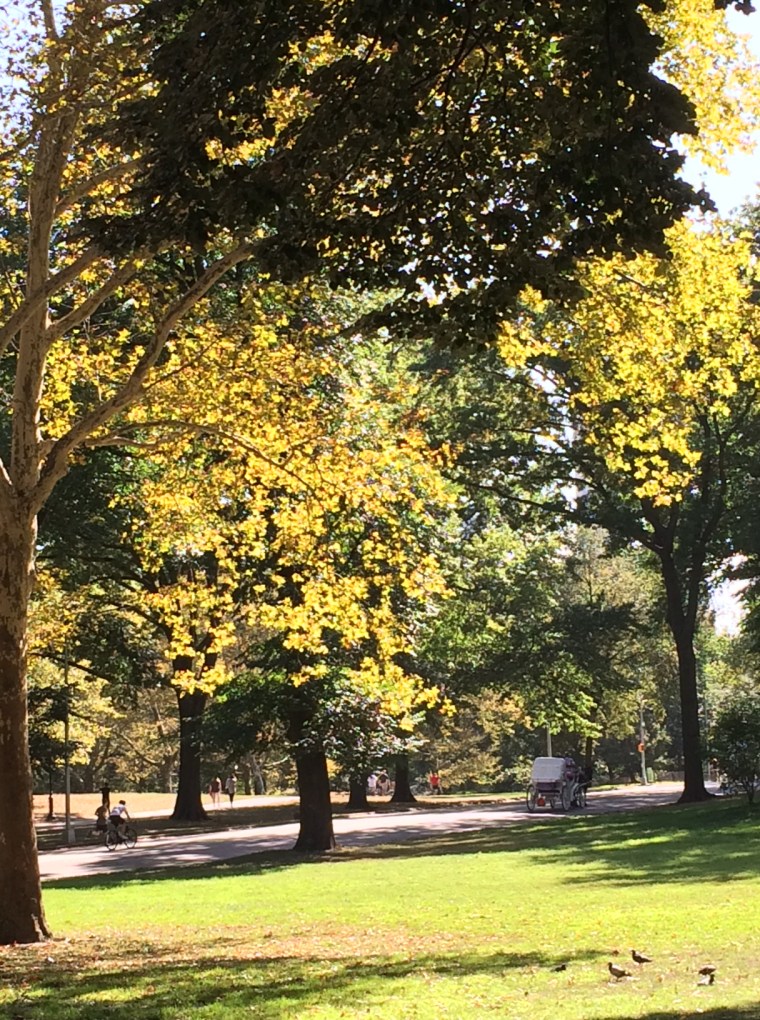
Yellow. The color of late September. Faded gold, gilded green, amber. In Central Park today, even the air appeared yellow as sunlight filtered through the thinning leaves. Throughout the park, yellow leaves lay scattered beneath the trees, on the roads, sidewalks, and grass. The day was unusually warm and the bright sun brought out the golden hues.

blog header September CP

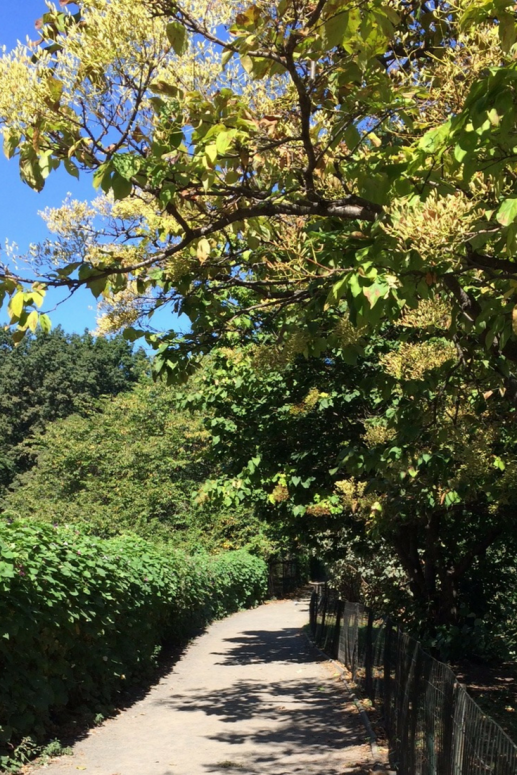
I strolled through one of my favorite walkways, a short path alongside a fence covered in a tangle of morning glories. The vines still showed pink and purple, with yellowed leaves mixed among the green.

yellow lane

Something caught my attention in the distance, and I had to stop and stare, puzzling out what I was seeing. A patch of air glittered among the yellow trees. I realized it was a shaft of sunlight shining on a spray of water from a sprinkler. Shadows boxed it in so that it looked like a square patch of sparkles hovering in the air.

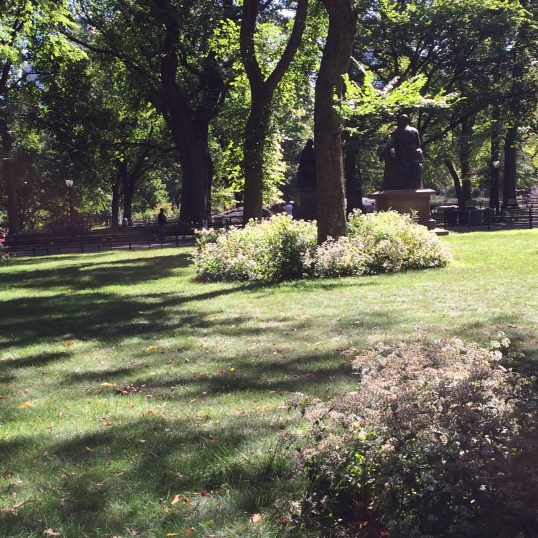
Straggly clusters of flowers still showed a bit of color, as in the clouds of white that surrounded the elms.

flowers elms

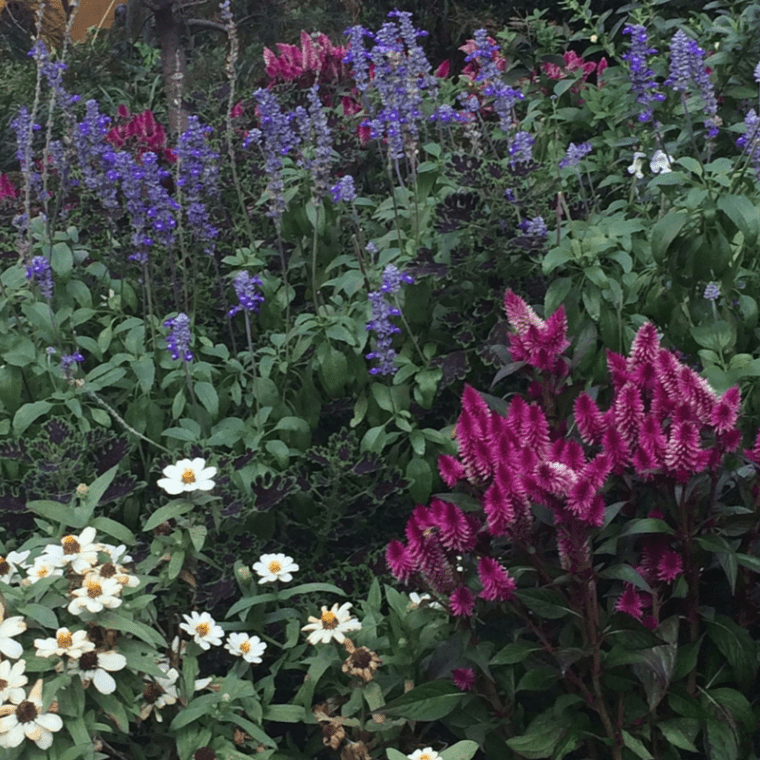
And though most flowers now have woody stems and drooping leaves, there are still vibrant patches of color to be found, soaking up the warmth of late September.

colored flowers

The weather will change soon and cooler temperatures will bring about the more dramatic colors of autumn. Who knows? By next week touches of orange and red might tinge the trees. And September’s soft yellow will shift to the sharper, more vibrant yellow of October.

leaf


A Sense of Sky

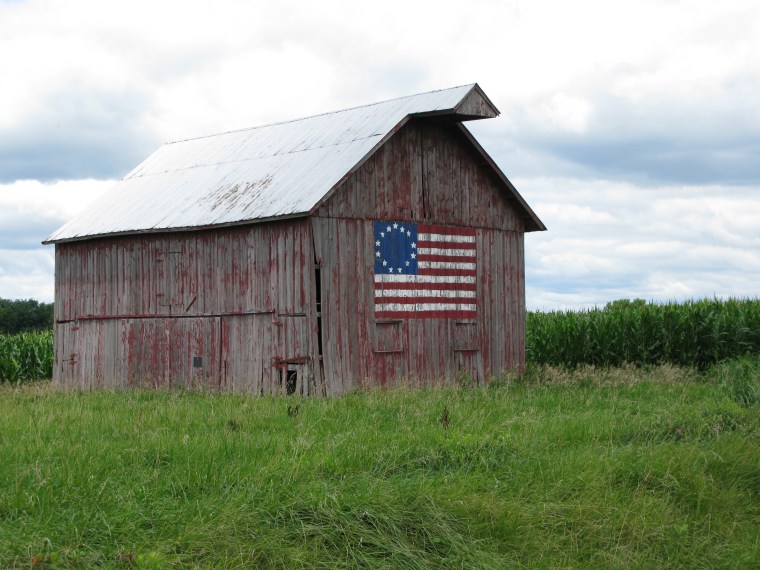
I’ve lived in New York City for almost thirty years and love it as much now as I did when I first moved here. But one of the things I miss, something from my girlhood, is the sense of sky — the wide-open vistas of the Midwest.

Image (483)

It’s a feeling of proportion you become aware of, driving along the Illinois fields, where the sky seems to take up a good two-thirds of the world. Here in New York I catch glimpses of sunsets or storm clouds between tall buildings, or over the rooftops. Beautiful, but without the sense that the sky dominates.

farmhouse Canva

I grew up with the drama of stormy skies over far-reaching fields, and the endless blue skies of summer with high, puffy white clouds, subtly changing, holding form just long enough for you to find an image before shape shifting again. To stand under such skies is humbling, and at the same time, makes you feel a part of something grand.

Image (477)

That sense of sky has found its way into some of my stories. In Christmastime 1943: A Love Story (Book Four of Six), a secondary plot takes place on a farm in Illinois. At different times throughout the story, Ed, the old farmhand, Kate, the owner of the farm, Ursula, her beautiful daughter, and Friedrich, the German POW, all look to the winter sky and find solace and beauty, or a reflection of their internal state.

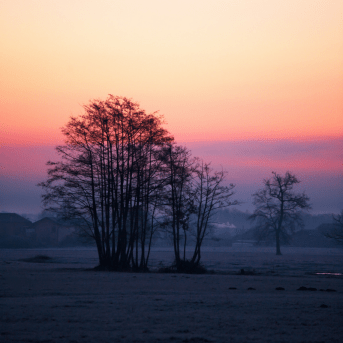
“[Ed] gazed out over the fields of corn stubble at the magnificent sunset. Bold streaks of orange and purple spanned the sky….Beautiful and strong – just like the women inside the farmhouse, he thought with a shake of his head.”sunset fields 1943.png

“[Ursula] stood at her window and gazed out over the late afternoon fields. The stubble of the corn fields shone a rosy gold in the setting sun. The sky filled with sweeping bands of deep blue and gray – at the horizon a shimmer of pink pulled at her heart. The sad beauty of the day filled her with longing.”

So I find that though I’ve moved away from Midwestern skies, they are still with me here, in New York City.

1943


The End of April

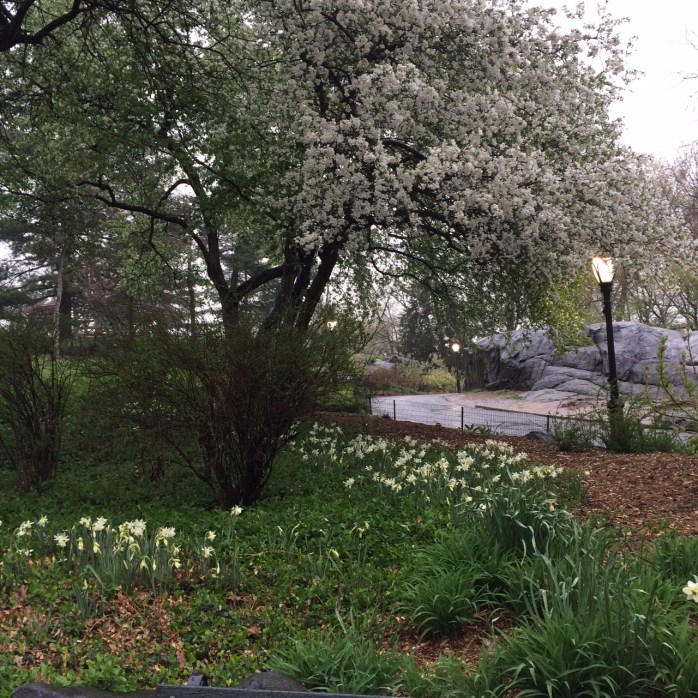
2 blossoming trees

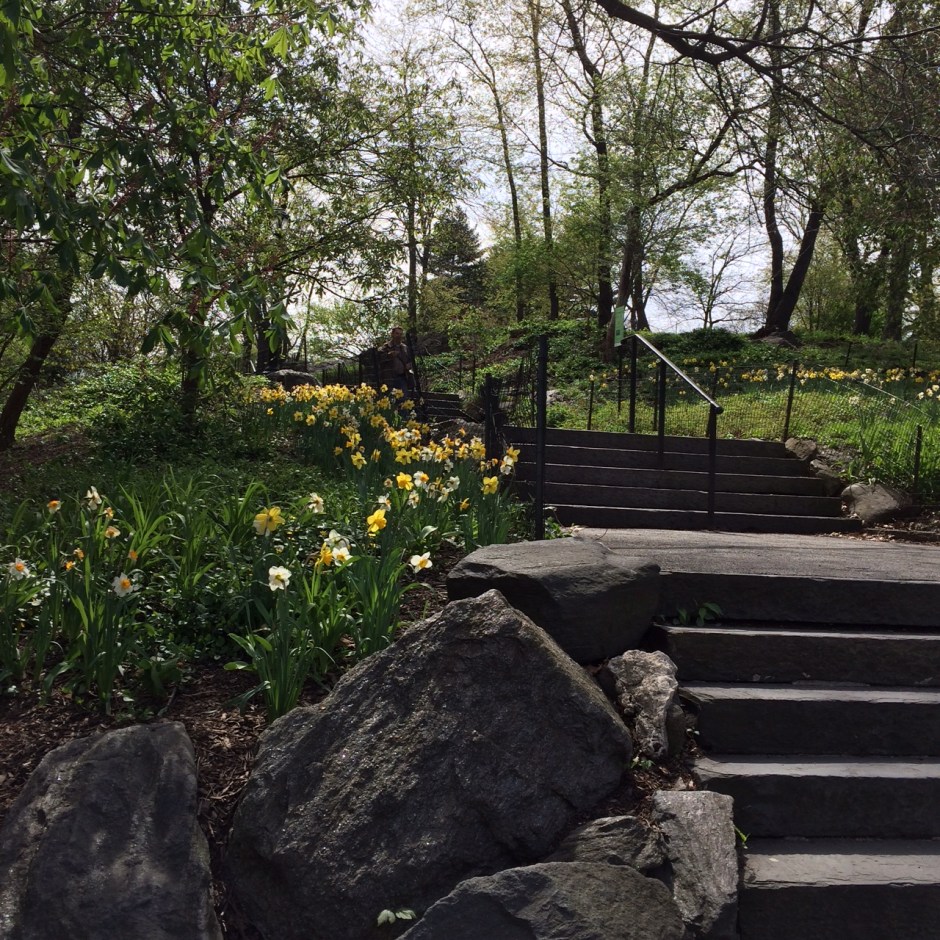
Do schoolchildren still sing the song “April Showers”? I think every year since I was a girl, some line, if not the whole song, runs through my mind in April. In an involuntary response, part of the melody just pops into my head when someone laments the rain, or when I come across a patch daffodils or violets.

daffodils for blog

A quick online search shows that the song was written in 1921 (in a period of post-war, pre-Depression optimism), and was introduced by Al Jolson in a Broadway musical. As can only be expected, the song’s  relentless optimism inspired parodies: “When April showers, she never closes the curtain…,” and a skit where a bucket of water is thrown on the far too cheerful performer. [https://en.wikipedia.org/wiki/April_Showers] (Some versions of the song, as with Judy Garland’s, begin with “When” rather than “Though.”)

April showers lyrics

Such sentimentality lingered on in the optimism of the 1960’s schoolroom, at least in small-town Illinois. On an old upright piano, our music teacher played from a repertoire that ranged from war songs to the flowers of spring, and the over-sized class of baby-boomers belted out tunes about violets, caissons rolling along, and flowers that bloom when the fairies sing.

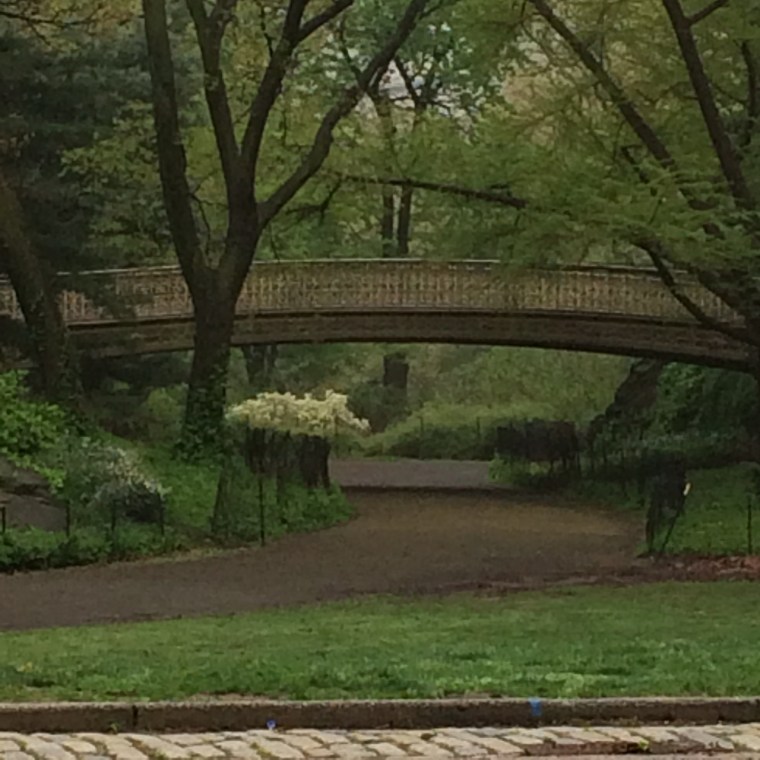
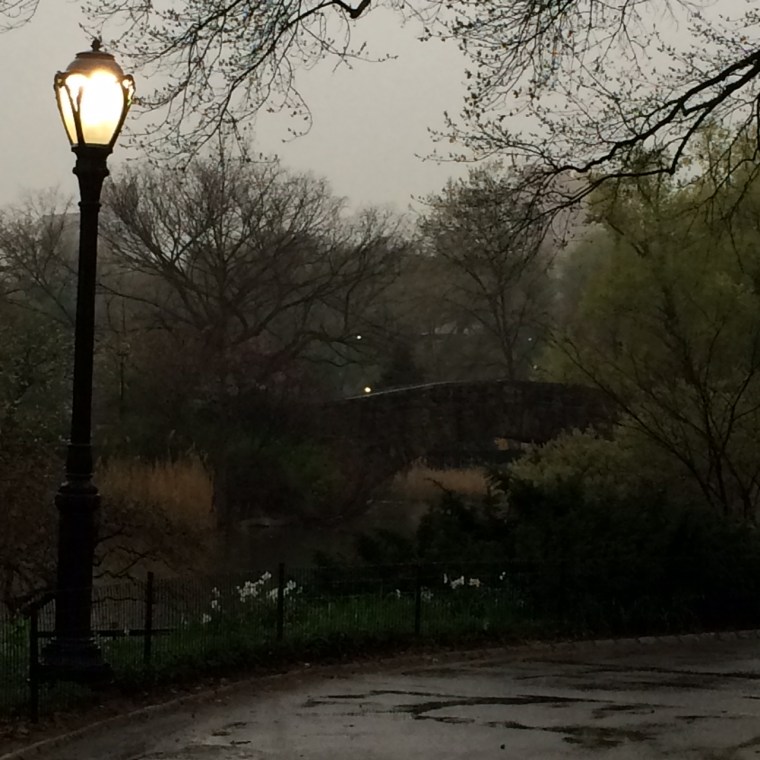
I love the rain of April and the color it brings. On such days the air itself seems tinged with green, so lush are the leaves and grass.

2 bridge

Green, rainy places have always held the most allure for me. On a trip years ago, I fell in love with Ireland and the Lake District in England — and very much want to go back. And a trip to Bangladesh had me gasping at such luxuriant green everywhere.

I actually moved to Seattle when I was young because I had heard that it was beautiful and hilly and green — and rainy. A soft rain was common enough, but dramatic storms with thunder and lightning, like Midwestern storms, were rare. Still, the soft rains kept Seattle blooming in flowers nearly all year long, and it lived up to its reputation as a beautiful, hilly, green city. (They call it the Emerald City and the last time I was there, they even had a yellow brick road to prove it.)

New York, like the Midwest, has seasons of intense green — April through June, for the most part. So when April showers come my way, I take my umbrella and indulge in the wealth of green.

2 post iris


2 tulips Columbus Circle

April Rain – Thursday morning

entrance 3

An early morning rain intensifies the colors in Central Park. The green becomes a vivid emerald. The azalea, a dazzling pink.

azalea

The stones and tree trunks turn rich gray and black, and the lamplight lingers, dotting the park with touches of gold.

Bride lamp rain

The soft patter muffles the din of the city, and the rain on the lake makes the most tranquil of sounds.

lake white tree rain

White blossoms lay scattered on the rain-dark pathways, and fall softly on the textured water of the lake. A quiet beauty suffuses the morning; the air is cool and fragrant.

Only a few feet away the city swirls in traffic, pedestrians rushing to work, horns blaring, stop lights and tail lights reflecting on the wet surfaces.

An old stone wall separates 59th Street from Central Park. On one side, the hustle and bustle of New York City. On the other, the serenity of the park, the beauty of nature.

bush tree rain

And spring is just beginning.


April Rituals

Bridge April

How are personal rituals formed, and what purpose do they serve? I have morning and evening rituals, ways of opening and closing the day. I have seasonal rituals, ways of marking time, of making it specific and memorable – as if putting a frame around a moment, a season, a month, so that it can be more closely looked at.

I think, for the most part, my rituals have been haphazardly formed. Some combination of actions clicked together agreeably at one time, and so I tried to recreate it again and again.

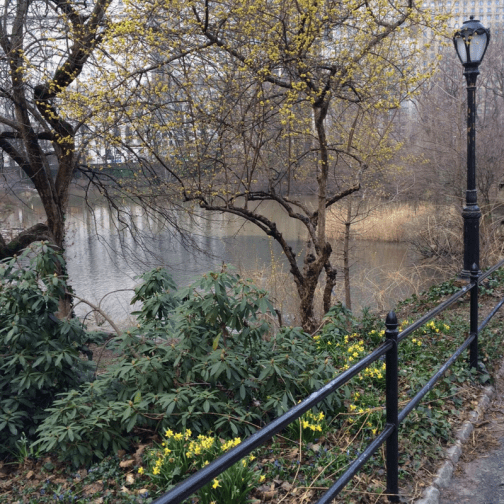
My spring rituals are largely determined by flowers. I search out the first blooms in Central Park – crocuses, daffodils, Forsythia. I plant my window boxes and choose the colorful annuals for the garden. Though I try to start the season in March, the cold of New York usually forces me to wait until April.

Though April is changeable, it can be counted on for a show of color – purple, yellow, pink, white. There’s a quince bush a few houses down that is among the first to flower in the neighborhood. I keep an eye on it, noting the first bits of green, then the dots of color as the buds begin to open. Then after a few sunny, mild days, the melon-colored flowers start to open, and there’s no suppressing the surge of pleasure they bring.


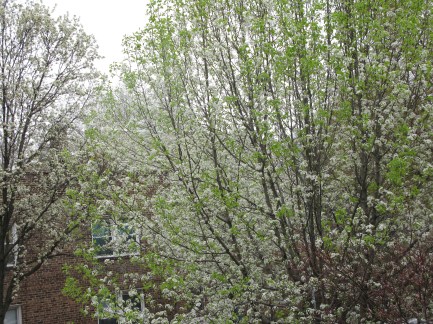
At about the same time, the pear trees along the street begin to bloom. My view at this time of year, as I write at the kitchen table, is that of white blossoms against the changing sky. In full bloom the trees are truly magnificent.

pix (530)

I can’t remember exactly how a particular April ritual got started, but several years ago I sought out the music of Thomas Morley’s “April is in My Mistress’ Face.” The time of year must have reminded me of the lyrics, and of the college music class where I first became enamored with the music of Palestrina, Bach, and Morley.green lute

An online search brought up several renditions of Morley’s Renaissance madrigal, many of them with a montage of spring flowers in the background. But the one I liked best showed a young woman looking very demure, and yet sensual and lovely. Instead of the usual four-part polyphonic voices, the melody was carried by a simple lute. http://bit.ly/2oTC1Eq

April is in my Mistress’ face,
And in her eye July hath place;
Within her bosom is September,
But in her heart a cold December.

I tend to ignore the last line. I like to think of his mistress as sweet and lovely in face and heart.

One of my April rituals then, is to fix a cup of tea, gaze out at the blossoming pear trees, and write – or perhaps it’s more honest to say I stare out the window and remember and dream, casting back into the past and forward into the future – trying to link the beauty outside the window and in the music with a sweetness that once was, or that, perhaps, could still be.

Is April, and spring itself, a larger metaphor for life, for youth, for a beautiful past (real or imagined)? Very likely. And so I do my best to hold it, to love it, to be a part of it – even as the white blossoms are being blown from the trees.

Canva blossom 1

The Four Seasons – today in Central Park

IMG_1433


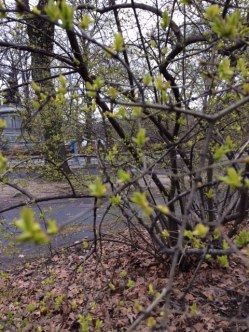
Even though the weather is still cold and spring is officially weeks away, I pulled on my jacket and gloves and headed to Central Park to check on the progress of spring. To see if more flowers had bloomed, if more bushes were beginning to bud. But instead of finding spring, I found all four seasons.

I stood on the little arched bridge over the pond, and from there I clearly saw winter. Against the backdrop of the Plaza Hotel, the pond still lay rimmed with ice.
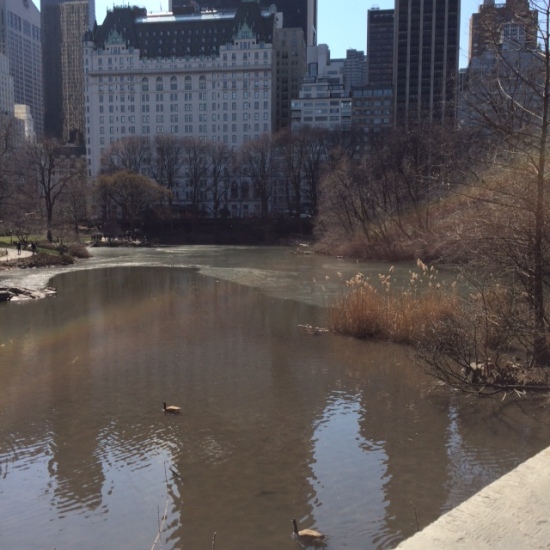
pond Plaza

The cattails and plants growing alongside appeared dormant, almost frozen. And behind me, came music from Wollman rink. There were the skaters, twirling, jumping, gliding over the ice.

Fall made its presence felt in the bare trees throughout the park, IMG_1429especially in the oaks. Their dry, brown leaves clung to the branches and lay scattered over the ground. They seemed to be tucked around all the clumps of flowers.
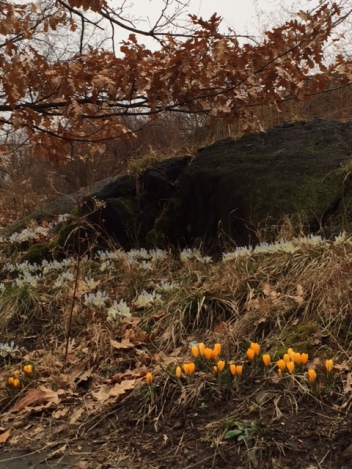
Under one such oak, I came across a little coupling of spring and fall, the contrast beautiful. A patch of crocuses nestled against a large black rock and above it, almost protectively, dipped the branch of curled brown oak leaves.IMG_1423
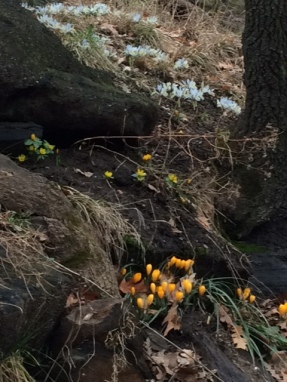
Spring was in the park, though at this time of year it seems to be close to the ground. There were bunches of green-speared daffodil leaves along the paths, and even a few daffodils in bloom.

I found a group of Lenten roses and some snowdrops, though like the daffodils, their blooms hung down, as if against the cold.

The sound of birdsong added to the sense of spring, as tiny birds flitted and chirped among bare branches. The forsythia bushes showed yellow, just waiting for a few warm days before bursting into fuller bloom. And that delicate first green appeared on several bushes.
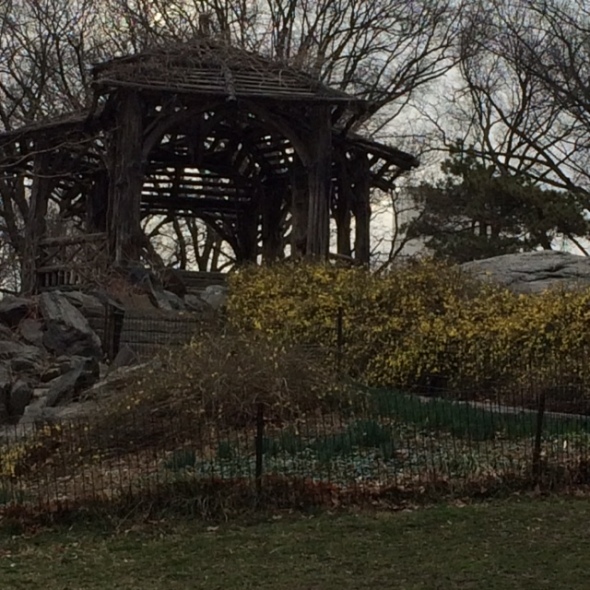
gazabo

The most spring-like thing I came across was a little sunlit patch of bright purple flowers that from a distance I thought were crocuses.

But up close, I found that they were something like miniature irises, almost forming a ground cover.

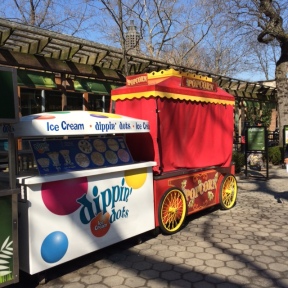
Summer?  A bit of a stretch to find, but it too was there. summer cartsThe tourists were out, so the crowds alone made it feel like summer. At the Children’s Zoo, a few food carts for ice cream and popcorn were parked, just waiting for milder weather before opening up for business.
And at one of the baseball fields, a group of young men were practicing their fielding. One man stood at home plate, hitting balls out to different positions. The sound of the ball against his metal bat was a real summer sound – a deep rhythmic ping, ping ringing in the air.

But the sky was shifting once again from blue to gray, and the clouds were now growing heavier. Rain was predicted for tomorrow. The temperature seemed to have dropped. Would we have snow? Spring was hiding its head and taking cover once again. I pulled up the hood of my jacket.

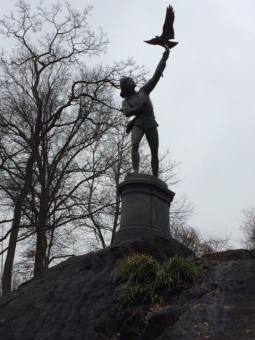
I passed the statue of the Falconer as I made my way out of the park. There he was, reaching up to a gray winter sky, undaunted by the cold. I tried to imagine him against the color and mildness of spring, and for the moment, I couldn’t. Falconer
Perhaps I am impatient. It’s just that I know what’s up ahead – Central Park in the spring is magnificent. But there is also something tender to be found in this subtle shifting of the seasons. It’s as if relationships are there among the dried leaves and green shoots, a protective urging forward, alongside a slow goodbye.

So I will slow down and appreciate this understated, changeable time of year. A time when we could have blossoms or snowflakes, and all the seasons are present. A remarkable time of year.