Summer — in The Christmastime Series

5 Kate's farm summer trees fence.jpg!d - Copy

Summer. A languid time of year that seems to move more slowly than the other seasons. Perhaps because the days are longer, or perhaps because many people are on vacation and the children are out of school, or perhaps because more time is spent outside, it is a rich time of year that creates indelible memories.


Memories of summer occasionally surface for some of the characters in my WWII Christmastime series, where most of the action is set in the cold and snow of December.


Though the stories take place on the home front, mostly in New York City, the events of the war shape the characters’ lives, making them fearful, anxious, and dreading the unknown. Adding to the tension are the attacks that take place in December — Pearl Harbor in 1941, and the surprise German counter-offensive in December 1944 that began the Battle of the Bulge.

For these characters, summer memories of a gentler and safer time soften the harsh realities of  war-time living. They remember bike rides along country roads, gathering garden flowers to place on the kitchen table and in bedrooms, afternoon picnics, a moonlit swim.


One memory in particular evokes the beauty and longing of late summer. In Christmastime 1941, Charles takes Lillian and her two sons to visit his sister Kate, who lives on a farm in Illinois. Lillian and Kate sit on the farmhouse porch in the late afternoon.

Lillian helped Kate finish the laundry, and then sat with her on the front porch, shucking corn for dinner.


A beautiful August day surrounded them in all its fullness and simple charm. A gentle breeze rustled the leaves high in the pin oaks, and fluttered the laundry on the clothes line, causing the white billowing sheets to snap softly now and then. The wide porch surrounded them with views of the corn and soybean fields stretching to the horizon. To the east stood a cluster of tall trees, their leaves a dark, dusty, late-summer green, with some leaves already edged in brown. And before them, Kate’s flowers along the lane – a tall tangle of orange, yellow, white, and blues – tiger lilies and daisies, cornflowers and asters.


Lillian lifted her face to catch the afternoon breeze, and caught the scent of honeysuckle that covered the fence along the lane. 


The wind alternately muffled and then sharpened the sounds of Tommy and Gabriel playing horseshoes with Kate’s sons: dull thuds as the horseshoes fell on the earth, clinks of metal as they hit their mark or landed on each other, mixed with clapping, laughing, good-natured disputing. Lillian had felt suffused with a sense of well-being, surrounded by an earthy loveliness.
2 clover in sunlight

Afternoon picnics, gardens in bloom, ripe fruits and vegetables, lush trees and fields — summer is the time of year when some of our strongest memories are born.

Beautiful Evening / Beau Soir


stream blog header

Sometimes the words of a phrase or sentence jars your center and subtly slips into your core, lodging there. It may be years later, or even decades, that you realize they have become a part of you. Many years ago, I came across a poem that had such an effect on me — “Beau Soir” by Paul Bourget, that Claude Debussy set to music.

Beau Soir

Lorsque au soleil couchant les rivières sont roses,
Et qu’un tiède frisson court sur les champs de blé,
Un conseil d’être heureux semble sortir des choses
Et monter vers le coeur troublé.
Un conseil de goûter le charme d’être au monde
Cependant qu’on est jeune et que le soir est beau
Car nous nous en allons,
Comme s’en va cette onde:
Elle à la mer,
Nous au tombeau.

wheat field sunset

Beautiful Evening

When streams turn pink in the setting sun,

And a slight shudder rushes through the fields of wheat,

A plea for happiness seems to rise from all things

And it climbs up towards the troubled heart.

A plea to relish the charm of life

While there is youth and the evening is fair,

For we pass away as the wave passes: 

The wave to the sea, and we to the grave.

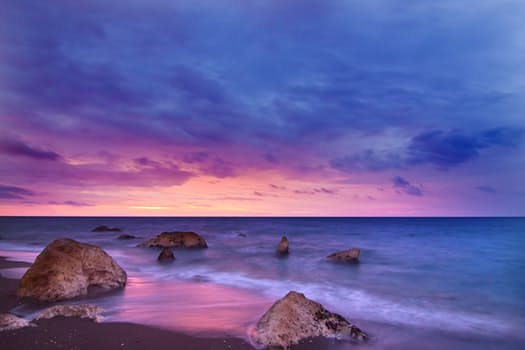
The tender intimacy of the poem, simple yet profound, stirred something deep inside and I sought out such end-of-day streams and fields, and later, ocean sunsets. The poem gave birth to a never-ending desire to seek out and become part of such moments of tranquil beauty.

pink purple ocean

It created a sort of urgency to embrace the loveliness of life — “while there is youth and the evening is fair.”


Oregon


soft sunset Vista House

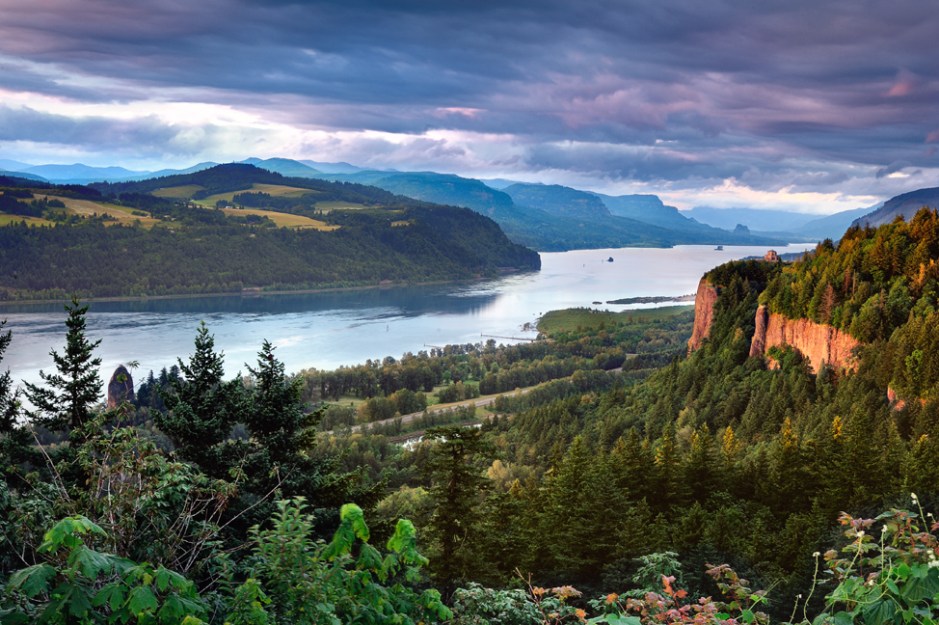
Every time I visit Oregon I’m left with the impression of the past and present mixing and shifting in a layering of influences. Though this is true of most places, it seems more pronounced in Oregon. My sister and her family live in Oregon and I’m lucky enough to visit there once a year, each time seeing someplace new.

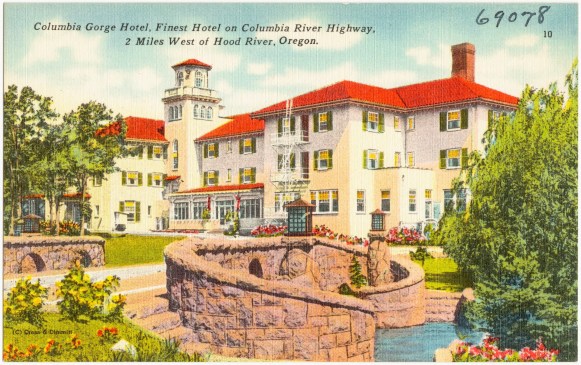
My visit this time began with a wedding at the Columbia Gorge Hotel, in Hood River. Mount Hood, majestic and always covered in snow, forms a backdrop to the hotel when viewed from the Washington side of the river.

The historic mission-styled hotel was built in the 1920s and retains the glamour that once attracted the likes of Rudolph Valentino and Clara Bow.

Old postcard Columbia River Gorge Hotel

“These were the days of steamers navigating the waters of the Columbia River from the Cascades to The Dalles. To alert the hotel, the captains would sound the whistle once for each guest he had on board. Maids would then quickly make up the appropriate number of beds….Simon Benson [owner] had just helped complete what many of the era claimed to be the world’s most beautiful road, the Columbia Gorge Scenic Highway. Benson’s dream was to create an opulent hotel for travelers at the end of this road.”

Source: ColumbiaGorgeHotel.com website, 2015

A picturesque stream, crossed by small stone bridges, runs through the grounds and ends in a rushing 90-foot waterfall that plunges into the Columbia River.

The river itself is steeped in the older history of the Lewis and Clark Expedition of 1804-1806, which began in St. Louis and ended where the Columbia River empties into the Pacific.

In fact, the very waterfall on the hotel grounds (the Wah Gwin Gwin Falls) is mentioned in their journals: “a butifull cascade falling over a rock of about 100 feet …” [Clark, October 29, 1805]. Their journals also describe the “Indian houses” along this section of the river and the sand bars “where the Indians caught fish.”

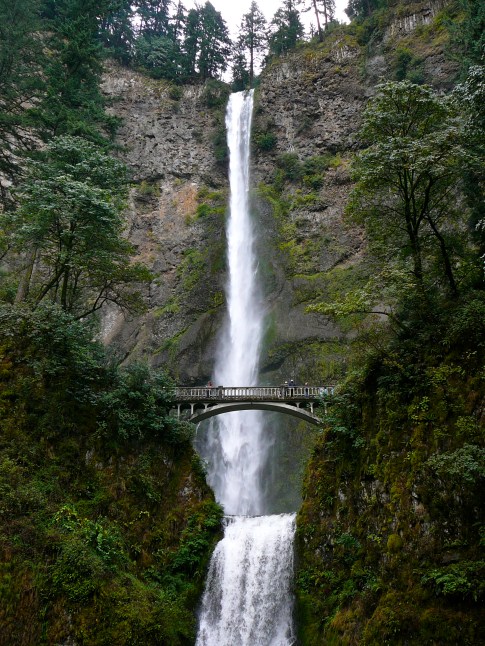
The Oregon landscape is imbued with Indian names that point to a deeper past, rich with the histories and legends of different tribes. Not far from the Columbia River is the stunning Multnomah Falls, one of the most photographed waterfalls in the world, and bound with the Wasco legend of a noble Indian maiden who sacrificed herself for her people.

Multnomah Falls free

The rest of my trip was spent a few hours south, near Roseburg. The Umpqua River dominates this area. Wide, rocky, and breathtakingly beautiful, the river cascades down from the mountains and flows to the Pacific. Where the river widens and slows, the South Umpqua, people “float” the river on rafts, inner tubes, and canoes.

The area is noted for its waterfalls, and hiking to them you can’t help but imagine a more distant time and feel the presence of the various tribes who walked the forest paths, hearing the same deafening roar of the waterfalls and feeling the same cooling mists.

A more recent layer of history woven into the landscape is that of the early settlers. There are places, such as Canyonville, where the ruts from the covered wagons can still be seen, evidence of the people who passed through the Applegate River and along the Rogue River. Some of the names of towns are reminders of the pioneers, and perhaps their impressions of places: Looking Glass, Steamboat, Riddle, Remote.

The valleys are still full of farms and ranches and orchards that were started by the pioneers. Century farms, “continuously owned by a single family for 100 years or more,” (Wikipedia) are plentiful. Some of the farms are beautifully preserved and give a glimpse into a harmonious way of living that was intricately bound with the seasons and the land.

Centruy farm

Other barns and farm structures, seen from the road, sag with the weight of time, or have collapsed completely.

More recent in the agricultural landscape are the vineyards, that are increasingly being planted. Though “settlers to the Oregon Territory planted grapes as early as the 1840s…the production of wine has only been a significant industry in Oregon since the 1960s” (Wikipedia). The Willamette Valley alone has over 500 wineries. Some are perched on hilltops that overlook rows of vines and give the countryside a European feel. Others, set along rushing rivers, are distinctly Oregonian in feel.

vineyard

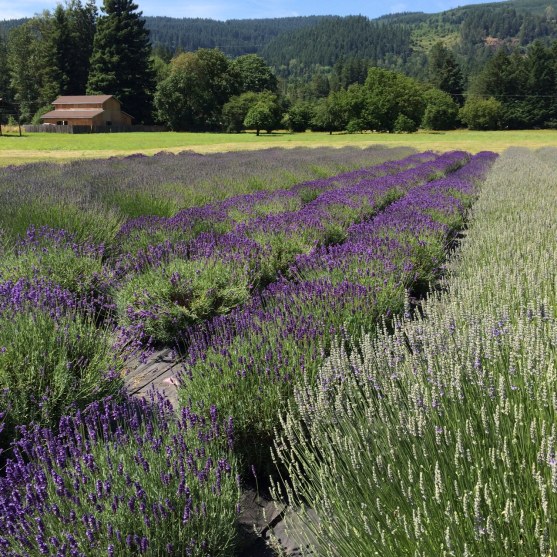
Oregon is also famous for its flowers, and on this visit taken at the end of June and early July, we sought out some fields of lavender. Though they were not quite in full bloom, their fragrance was strong — fresh, clean, and uplifting — and I bought some vials of lavender oil to take with me back to New York. So much of the landscape inspires a sense of beauty and well-being and the lavender oil seems to capture that.

lavender field

On my last evening in Oregon, we took a walk along a country road that overlooked the valley below. The coastal clouds, like a slow-moving wave, gently blanketed the rolling hills, and the setting sun cast the farmland below in a soft golden light. Magical.

sunset end