The autumn leaves are falling like rain…

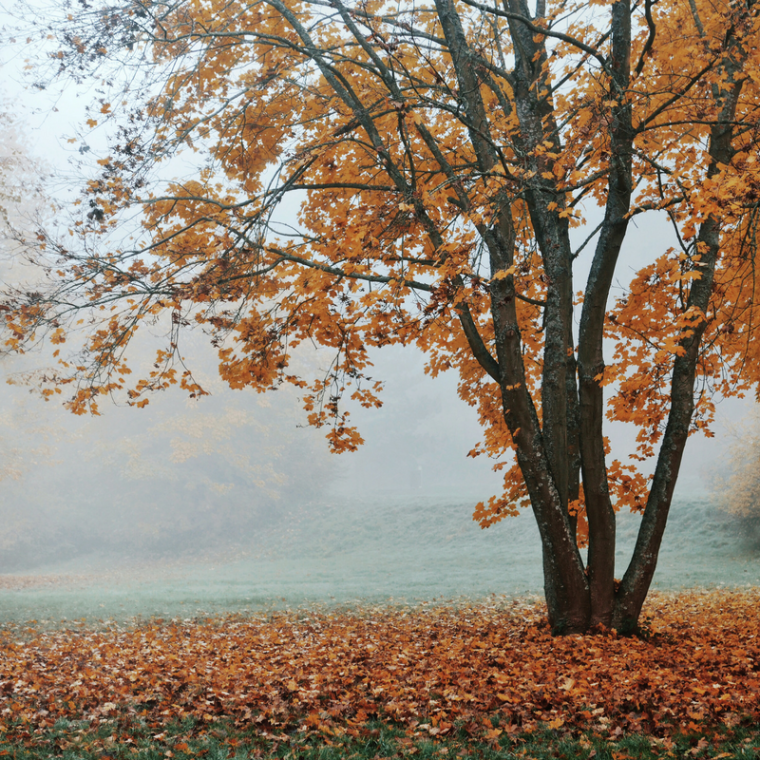
autumn mist and leaves

There’s a poem I’ve come across over the years that is simple, beautiful, and lyrical. It seems to find expression in different times, in slightly different wording. All the versions are evocative, stirring up rich images and emotions.

The autumn leaves are falling like rain,
Although my neighbors are all barbarians,
And you, you are a thousand miles away,
There are always two cups at my table.   – Tang Dynasty poem

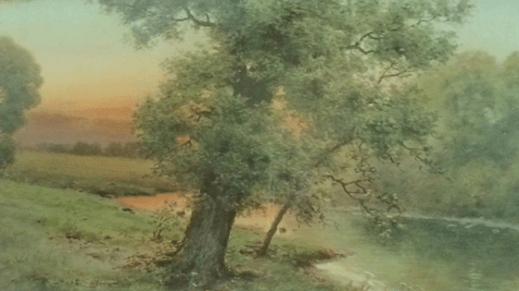
In this version, most likely translated from the original, I imagine a rugged landscape,
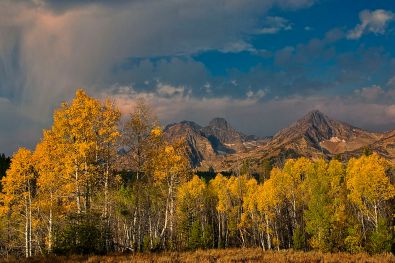
rugged autumn


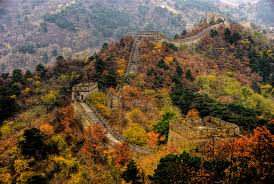
perhaps the Great Wall of China,

GW China autumn

and a cup of tea.

Chinese teacup

A quick search reveals a few remarkable facts about the period the poem was written in: “China’s Tang Dynasty, 618-907, is often considered the Golden Age of Chinese poetry. During this period, poetry was an important part of social life at all levels of society. Scholars were required to master poetry for the civil service exams, but the art was theoretically available to everyone. Tang poetry has had an ongoing influence on world literature.” (Wikipedia)

However, there are other, similar versions of the poem. Perhaps the poem has been been translated in various ways throughout the years, or perhaps different poets were moved by the universality of the poem and reworked it for their time and place.

For example, this later version about an earlier period, is said to describe the far reaches of Britannia under Roman rule:

Here at the frontier 
There are fallen gods 
And my neighbours 
Are all barbarians 
Although you 
Are thousands of miles away 
There will always be on my table 
Your cup.

Different imagery comes to mind: the wall morphs to Hadrian’s Wall, the landscape shifts to bleak highlands. I imagine damp cloaks, stomping horses, tents pitched next to a sputtering campfire.

And more recently, these lines, close to the original, appear in John Fowles’ The Magus:

“Here at the frontier there are falling leaves; although my neighbors are all barbarians, and you, You are a thousand miles away. There are always two cups at my table.”
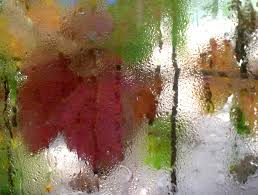
rainy leaves window

All the versions suggest forced separation – perhaps by war, conquest, travel of some sort – contrasted with the memory of friendship, the comforts of home, civility.  They speak of longing, memory, and the hope for future togetherness. And most of all, they express that it’s the simple things in life that have the greatest pull on us.


Travel – Bangladesh

winter-morning-rice field

In the mornings, I stood on the bedroom balcony, and closed my eyes as I listened to the sounds of Bangladesh: bells from the bicycle rickshaws, short beeps from the motorbikes, the alluring call of the muezzin from the nearby mosque. Small birds chirped from trees that rose up past the balcony, and geese squawked and flapped their wings in the neighboring yard.

rickshaw

One day,  as I was writing, I heard music coming from the street, and I ran downstairs to the front veranda to see what it was. I was delighted to find an enchanting procession passing by on the dirt road outside the house. But then I was told that it was a Hindu funeral and they were on their way to the cremation. Carried on the shoulders of six men was a wicker bier on which the body was laid, its head rocking back and forth with the movement of their walking. The men held burning sticks of incense, and the group that followed made rhythmic sounds from bells and tiny brass instruments. It was a day-to-day event, and the other people on the street took little notice.

A group of giggling schoolgirls in uniforms of pale blue and white passed by, their black hair neatly arranged in buns or in braids. Vendors passed the procession, bent only on selling their wares: a stick-thin man with a bamboo pole across his shoulders with baskets of vegetables on either end, the bangle lady enticing the women in the houses with her cries of “churi, churi!” and a man carrying a colorful stack of cloth on his head. Life and death were in easy company on the busy, dusty street.

Folk_Art_Museum_Sonargaon


Beautiful Evening / Beau Soir


stream blog header

Sometimes the words of a phrase or sentence jars your center and subtly slips into your core, lodging there. It may be years later, or even decades, that you realize they have become a part of you. Many years ago, I came across a poem that had such an effect on me — “Beau Soir” by Paul Bourget, that Claude Debussy set to music.

Beau Soir

Lorsque au soleil couchant les rivières sont roses,
Et qu’un tiède frisson court sur les champs de blé,
Un conseil d’être heureux semble sortir des choses
Et monter vers le coeur troublé.
Un conseil de goûter le charme d’être au monde
Cependant qu’on est jeune et que le soir est beau
Car nous nous en allons,
Comme s’en va cette onde:
Elle à la mer,
Nous au tombeau.

wheat field sunset

Beautiful Evening

When streams turn pink in the setting sun,

And a slight shudder rushes through the fields of wheat,

A plea for happiness seems to rise from all things

And it climbs up towards the troubled heart.

A plea to relish the charm of life

While there is youth and the evening is fair,

For we pass away as the wave passes: 

The wave to the sea, and we to the grave.

The tender intimacy of the poem, simple yet profound, stirred something deep inside and I sought out such end-of-day streams and fields, and later, ocean sunsets. The poem gave birth to a never-ending desire to seek out and become part of such moments of tranquil beauty.

pink purple ocean

It created a sort of urgency to embrace the loveliness of life — “while there is youth and the evening is fair.”


Venice

venice sunset

An early, hushed Sunday morning in New York City. Cool air wafts through the open window. I sit at my kitchen table with a cup of tea from the set I bought in a little town outside of Portland over twenty years ago. My “cottage set” I’ve always called it – a round teapot and heavy mugs, deep blue with garlands of flowers on them, the handles like twisted branches. They always bring to mind the Cotswolds and thatched cottages with gardens – though I’m far from any kind of cottage existence.

A dense fog last night leaves the flowers in my window boxes dewy and fresh. In the distance, I hear a lone train whistle from the Sunnyside train yard, the early chirping of birds, the muted peal of faraway church bells, the low passing rumble of a car or two a few blocks over.

My mind is focused on the writing at hand – when in the morning quiet, I hear the click click of a woman’s heels on the sidewalk below – and immediately I’m back in Venice.

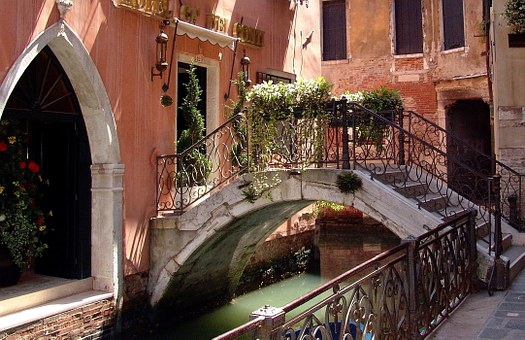
Venice beautiful bridge

Exhausted upon our arrival, we rested in the early evening, almost asleep. And through the open window, we heard for the first time the sound that would forever remind us of Venice: the clicking of women’s heels in otherwise silence, ever so slightly echoing in the narrow calli below – mysterious, intriguing, beguiling. Who is she? Why is she alone? Where is she going?

I take a sip of tea, glance out the window, and decide that I must go back there – to the city of soft summer evenings, canals and bridges, and breathtaking beauty.

venice end of day